
Low Engagement? 8 Ways to Fix Your Content Strategy
Is your content failing to connect with your audience? Here’s the solution: focus on strategies that boost engagement, create real connections, and drive results. This article breaks down 8 actionable tactics to improve your content strategy and turn passive viewers into active, loyal followers.
Key Takeaways:
Use Analytics: Tools like Google Analytics or TikTok Insights help you understand what works and refine your approach.
Incorporate Video & Interactive Content: Videos generate up to 1,200% more shares, while polls and quizzes double engagement rates.
Create a Content Calendar: Consistent posting builds trust and keeps your audience engaged.
Diversify Content Types: Mix short-form, long-form, and interactive formats to appeal to different preferences.
Post at Optimal Times: Engagement spikes when you post during peak activity hours.
Tailor Content for Platforms: Platform-specific content performs 3–5x better than generic posts.
Add Polls & Interactive Features: Simple polls can achieve engagement rates of 6–10%.
Combine Organic & Paid Content: Boost high-performing organic posts with paid campaigns to expand reach.
By implementing these strategies, you can increase interaction rates by up to 89% and improve conversions by 156%. Start small by testing two or three tactics this week and track your progress using measurable metrics like saves, shares, and comments.
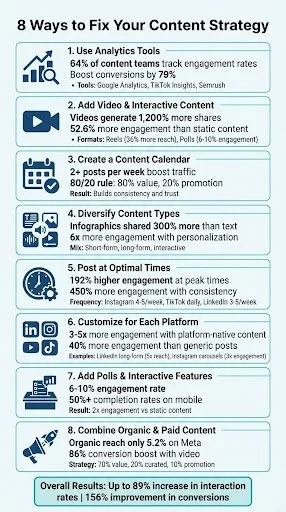
8 Content Strategy Tactics to Boost Engagement: Quick Reference Guide
5 EASY ways to DOUBLE your engagement on social media | 2026 STRATEGIES | Instagram YouTube & TikTok
If you want to improve your content, you need to know what's working and what isn't. Analytics tools can turn guesses into actionable insights by showing you exactly who’s engaging with your content and why. For web metrics like time on page, bounce rates, and conversion paths, Google Analytics is a go-to option. For social media, platforms likeYouTube Studio,Meta Business Suite, andTikTok Analytics provide detailed insights into demographics, retention, and peak activity times. Tools like heatmaps and scroll depth tracking are also invaluable for pinpointing where users click, hover, or lose interest. To go even further, apps likeSemrush andAhrefs uncover high-performing topics and trending keywords that resonate with your audience.Pay attention to what your data is telling you. If certain posts are being saved or shared more than others, it’s a sign to create more of that type of content. Additionally, tracking micro-conversions - like newsletter sign-ups or resource downloads - can help you tie audience engagement to your business goals.
"Engagement rates - likes, comments, and shares - remain the top metric for 64% of content teams, proving that authentic audience interaction is the ultimate sign of quality content."
- Contesimal
Effectiveness in Improving Engagement
This approach is a game-changer for refining your content strategy. By analyzing patterns in your best-performing content - whether it’s a specific topic, format, or posting time - you can focus on replicating success rather than guessing what might work. For example, updating older content based on analytics can increase engagement by 53%. Even better, this deeper understanding of your audience’s behavior can boost conversion rates by up to 79%.
Ease of Implementation
The good news? Most social media platforms already offer user-friendly dashboards that make tracking engagement simple, even if you’re just starting out. Setting up event tracking in Google Analytics or reviewing Instagram Insights can be done in minutes, so you don’t need to be a tech expert to get started.
Relevance to Diverse Audiences
Analytics also let you break down your audience into segments based on demographics, behavior, and platform preferences. For example, younger audiences may prefer short, snappy TikTok videos, while professionals might engage more with in-depth LinkedIn articles. Metrics like watch time or scroll depth can also reveal where people lose interest, giving you the chance to adjust your content’s length or complexity.
Potential for Measurable Results
By 2025, over half of marketers are expected to track engagement on social media and websites as their main performance metrics. Setting baseline KPIs and testing changes - like tweaking headlines or adding videos - allows you to measure results with precision. Engagement benchmarks vary by platform: Instagram averages 4.2%, LinkedIn 2.8%, and TikTok 2.50%, giving you clear targets to aim for.
2. Add Video and Interactive Content Formats
Breathe life into static content by incorporating videos and interactive formats. On Pinterest, video content achieves a median engagement rate of 5.75%, which is nearly double the 3.15% rate for static images. Instagram Reels, designed for discovery, generate around 36% more reach than carousels. Meanwhile, LinkedIn carousels boast a 21.77% median engagement rate, tripling the performance of standard posts.
Creating effective video content means embracing visual variety and keeping the pace lively. Features like jump cuts, captions, and an early "aha" moment help grab attention quickly. Interactive quizzes and assessments also shine, with completion rates ranging from 35% to 55%. Even more impressive, live streams can achieve conversion rates as high as 30%, which is up to ten times better than traditional e-commerce methods.
"Interactive content invites the user to actively participate... creating a personalized experience that feels more like a conversation than a one-sided message."
- ShortStack
Effectiveness in Improving Engagement
Interactive formats outperform static ones by generating 52.6% more engagement. They also deliver twice the conversions compared to passive content. Short-form videos, like TikToks or Reels, typically see a 3–5% view-to-profile visit rate and a 0.7–1.5% click-through rate from bio links. For a more in-depth connection, long-form content such as YouTube videos or webinars builds trust and authority, often resulting in longer average view durations. Platforms likeVimeo make it easy to embed clickable hotspots and calls-to-action directly into videos, while tools likeApester andQzzr simplify creating interactive quizzes and polls without requiring coding skills.
Ease of Implementation
You don’t need a massive budget to get started. Most social platforms already support native video formats, and tools likeFlourish can transform spreadsheets into animated visuals in just minutes. For quizzes and polls, platforms such as ShortStack andOutgrow offer drag-and-drop templates that are beginner-friendly. Video templates can cut editing time down to just 1–2 hours per clip. If you're new to interactive content, start with simple polls or quizzes before moving on to more advanced tools like augmented reality or custom calculators.
Relevance to Diverse Audiences
Understanding your audience’s preferences is key to choosing the right format. Short-form videos are perfect for quick engagement and top-of-funnel discovery, while long-form content like webinars works better for building credibility with professionals. With nearly 60% of web traffic coming from mobile devices, ensure that interactive elements are optimized for smaller screens, using large text and thumb-friendly buttons. Industries like finance, fitness, and real estate can benefit greatly from interactive calculators, which provide users with immediate, tailored results for complex decisions.
Potential for Measurable Results
Interactive and video content offers clear opportunities for tracking performance. Metrics like quiz completion rates (35–55%), time-on-page, social shares, and lead capture rates (20–35%) help evaluate success. On average, users spend twice as long on pages with interactive elements compared to static ones. Adding videos to landing pages can boost conversion rates by up to 86%. To refine your strategy, A/B test different formats - like comparing a quiz to a clickable hotspot - and see which resonates most with your audience.
3. Create a Content Calendar and Stick to It
Posting randomly can harm your audience's trust. A content calendar shifts you from chaotic, last-minute efforts to a well-thought-out plan that builds credibility and authority. By organizing your content around key themes, both your audience and search engines will start recognizing your expertise in specific areas. This strategy ensures every piece of content has a clear role in guiding your audience through their journey - from awareness to making decisions.
"Planning your content frees up mental energy. Instead of constantly worrying about what's next, you can focus on what you do best: creating high-quality, impactful posts."
- PostNitro
Effectiveness in Improving Engagement
A structured content calendar allows you to follow the 80/20 rule: dedicate 80% of your content to providing value - whether that’s educating or entertaining - and limit promotional content to just 20%. Research shows that publishing at least two blog posts per week can significantly boost traffic and engagement. Additionally, repurposing content can stretch your efforts further.
For example, a single in-depth blog post can be repackaged into carousels, reels, or threads, helping you reach more people without overwhelming your team. It's worth noting that one-third of B2B marketers struggle with their content strategies due to unclear goals or poor planning. A content calendar keeps you focused on what matters most, ensuring your efforts drive results.
Ease of Implementation
You don’t need fancy tools to get started. Free options like Google Sheets or Excel are perfect for solo creators or small teams and allow you to fully customize your plan. Begin by defining 3–5 core content pillars that align with your audience’s interests and your brand’s strengths. Then, set a realistic posting schedule - 2–3 high-quality posts per week often outperform a daily schedule that risks burnout. Build in a 20%buffer to your timelines to accommodate unexpected delays or opportunities to address trending topics.
Potential for Measurable Results
A calendar simplifies tracking your content’s performance. Set clear, SMART goals for each post - like getting 35+ comments or boosting organic traffic by 14% quarter-over-quarter - rather than vague objectives like “increase engagement.” Conduct regular audits, either monthly or quarterly, to identify what’s working and what isn’t. Mapping your content to specific funnel stages (awareness, consideration, decision) also helps you measure key metrics like click-through rates, time on page, or lead magnet downloads. These insights make it easier to see how each piece of content contributes to your overall goals.
Up next, learn how to balance different content types to enhance your strategy.
4. Balance Different Types of Content
Focusing on only one type of content is like trying to communicate with just part of your audience. Some people love quick, visual formats like Reels or infographics, while others prefer to dive into detailed blog posts or case studies. For instance, video content generates 1,200% more shares compared to text-only posts, and infographics are shared 300% more often than plain articles. On Instagram, Reels deliver 36% higher reach, and carousels drive 12% higher engagement. By mixing up your formats, you ensure you're reaching and engaging a broader audience. This approach not only caters to diverse preferences but also aligns with different stages of the customer journey.
Effectiveness in Improving Engagement
Each content type serves a purpose, especially when tied to specific goals in the customer journey. For example, short-form videos and memes are perfect for building awareness, while detailed tutorials or case studies are better suited for the consideration stage. Interactive elements like polls or quizzes can help nudge users toward making decisions. Interactive content, in particular, performs well - polls and quizzes generate twice the engagement of static posts. On LinkedIn, carousels achieve a median engagement rate of 21.77%, nearly three times higher than videos or images. The trick is to pair the right format with your goals: use short videos to boost reach, and rely on carousels or interactive tools for deeper engagement.
Ease of Implementation
You don’t need to start from scratch. Repurpose your existing content to save time and effort. For example, turn a detailed blog post into an infographic, split it into short video clips, or create a downloadable checklist from the same material. This approach lets you stretch your resources while keeping your team from feeling overwhelmed. With nearly 60% of web traffic coming from mobile devices, optimizing for mobile is non-negotiable. Use large text, concise paragraphs, and buttons that are easy to tap with a thumb.
Potential for Measurable Results
Focus on metrics that matter. While likes are nice, actionable metrics like saves (which show lasting value) and shares (which reflect trust) are far more meaningful. You can measure engagement rate using this formula: (Total Engagements / Total Reach) x 100. Personalizing content for specific audience segments can result in 6x more engagement than generic posts. Test different formats and track performance indicators to find out what resonates most with your audience.
Up next, explore how timing and frequency can further enhance your content’s impact.
5. Post at the Right Times and Frequency
Timing can make or break your content's performance. Posting when your audience is actively online helps your content gain traction quickly, which is crucial for triggering algorithmic distribution. Posts that see engagement within the first 30–60 minutes are far more likely to reach a wider audience, while those that remain idle fade into obscurity. In fact, hitting those optimal posting windows can boost engagement rates by 192% and expand your reach by 93%. This ties back to the importance of using analytics to guide your strategy.
Effectiveness in Improving Engagement
While timing is important, consistency is the real game-changer. Accounts that post at least once a week for 20 or more weeks out of 26 see 450% higher engagement per post compared to those with irregular posting habits. Even moving from sporadic posting (4 weeks or less) to a slightly steadier schedule (5–19 weeks) can drive engagement up by 340%.
The ideal posting frequency depends on the platform. For example:
Instagram: 4–5 posts per week work well.
TikTok: Daily posts are most effective.
LinkedIn: 3–5 posts per week can significantly increase impressions.
On LinkedIn specifically, posting 2–5 times per week can lead to an additional 1,180 impressions per post compared to posting just once.
Ease of Implementation
Finding the right posting times doesn’t have to be complicated. Use built-in analytics tools like Instagram's Professional Dashboard, TikTok Creator Tools, or Facebook Insights to identify when your audience is most active. Once you know the peak times, try the "15-Minute Rule" - post 15 minutes before peak activity to capture early engagement.
To make things easier, consider using scheduling tools to batch-create and plan posts in advance, so you’re not glued to your phone. Also, establish a "Lowest Viable Cadence", which is the minimum posting frequency you can sustain over the long term - this could be as few as 2–3 posts per week.
Potential for Measurable Results
Measure engagement with this formula: (Total Engagements / Total Impressions) x 100. But don’t just hit "post" and walk away - stick around for 15–20 minutes afterward to respond to early comments. This small effort can lead to 9.5% more reactions on platforms like Facebook. On Threads, replying to comments can boost engagement by up to 42%, while on LinkedIn, it can increase by 30%.
Keep an eye on when your posting frequency starts to hurt rather than help. For example, on Instagram, reach gains tend to level off after 3–5 posts per week. Adjust your strategy by tailoring content to each platform for even better results.
"Sharing your social media posts at the 'right' time is not the secret sauce for content success. If there were a secret sauce, it would be consistency."
-Kirsti Lang, Senior Content Writer, Buffer
6. Customize Content for Each Platform
When it comes to content strategy, one size definitely doesn’t fit all. Each platform has its own vibe, technical quirks, and audience habits. And in 2026, algorithms are laser-focused on rewarding content crafted specifically for their environment. Here’s the kicker: platform-native content can drive 3–5x more engagement than simply recycling posts across channels. By tailoring your content, you’re not just meeting expectations - you’re exceeding them.
Effectiveness in Improving Engagement
Here’s a stat to keep in mind: customized content generates 40% more engagement compared to generic, repurposed posts. For instance, Instagram Reels boast 67% more reach than posts with external links. LinkedIn? Long-form posts over 1,300 characters can achieve 5x more reach than shorter updates. And on Instagram, carousels outperform single-image posts by 3x in terms of engagement. These differences aren’t just numbers - they’re opportunities to fine-tune your strategy and make a real impact.
The secret lies in understanding the mindset of each platform’s audience. LinkedIn users are looking for professional insights and thought leadership, so detailed posts and PDF carousels tend to shine. TikTok users? They want content that feels authentic and blends education with entertainment. Meanwhile, Instagram audiences gravitate toward visually striking, polished posts. When your content reflects these nuances, engagement becomes a natural byproduct.
Ease of Implementation
Here’s the good news: you don’t need to start from scratch every time. Instead, take a core piece of content - like a blog post or video - and adapt it into platform-specific formats. For example, turn a blog into TikTok clips, Instagram Reels, or an engaging LinkedIn post. The magic lies in how you adapt, not in creating entirely new material.
Pay attention to technical details that can make or break your reach. Use the correct aspect ratios (e.g., 9:16 for Reels and TikTok, 4:5 for Instagram, 2:3 for Pinterest) and avoid watermarks, which algorithms often penalize. Also, those first few seconds matter - a lot. Craft hooks that resonate with each platform’s culture. And since 85% of social media videos are watched without sound, captions aren’t optional - they’re a must.
With these tweaks, you’ll not only align with platform algorithms but also make your content more accessible and engaging.
Potential for Measurable Results
To gauge success, compare engagement across platforms using the same core message in varied formats. For LinkedIn, focus on the first 60 minutes of engagement, as that’s when the platform determines whether to boost your post. On Instagram, test carousels against Reels to see what clicks with your audience. Use tools like Instagram Insights, TikTok Creator Tools, and LinkedIn Analytics to dig into the data and refine your approach.
"It's not about being everywhere. It's about being present in the right way, in the right places."
-Mark, Business Coach
Next, we’ll dive into how adding interactive elements like polls can take your engagement even further.
7. Add Polls and Other Interactive Features
Effectiveness in Improving Engagement
Polls and quizzes have engagement rates between 6–10%, far surpassing the 1–2% for text and 2–3% for images. Why? People enjoy sharing their opinions and comparing their thoughts with others. Polls grab attention, interrupt the endless scroll, and tap into the natural desire for validation - seeing how personal views align with the crowd.
When users contribute to decisions, like voting on a new product flavor, it triggers the IKEA Effect. This psychological phenomenon means people feel a stronger connection to your brand because they’ve been part of the process.
Ease of Implementation
Polls are incredibly easy to set up. Social media platforms like Instagram (Story stickers for polls, sliders, or question boxes), Twitter/X (poll features), and LinkedIn (native poll tools) make it straightforward. For websites or email campaigns, tools likePOWR, Outgrow, and ShortStack let you add interactive features without needing to code. This seamless integration makes engagement simple across all your channels.
Keep social media polls short - stick to 1–2 questions to avoid overwhelming participants. Make it as effortless as possible; a single tap should suffice. Want to encourage participation? Answer the poll yourself first. This lowers the barrier for others to join in. Once the poll ends, share the results and explain how the feedback influenced your decisions (e.g., "You voted for X, so we created Y").
Potential for Measurable Results
Track metrics like engagement, completion, and social share rates. Mobile-friendly polls often see completion rates above 50%, and live polls can generate 25–45% more responses than traditional surveys. Compare these results to your usual performance to gauge the impact. This data-driven approach fits perfectly into your broader strategy for boosting audience interaction.
"Interactive content can generate twice the engagement of static content? That's right - twice."
-Mick Essex, POWR
Dive deeper into the data by segmenting responses by demographics - age, location, or device type. This not only helps measure engagement but also uncovers what your audience cares about most, giving you a clear direction for future content planning.
8. Combine Organic and Paid Content with Burt's Media Custom Plan
Effectiveness in Improving Engagement
Organic reach on social media is shrinking fast. For instance, brand pages on Meta platforms now reach just 5.2% of their followers organically. Over on X (formerly Twitter), things are even bleaker - non-paid accounts saw median engagement rates drop to 0% in early 2025, while Premium accounts managed to maintain visibility. With organic reach at such low levels, combining organic and paid strategies isn't just smart - it's necessary.
The key isn’t about choosing one over the other; it’s about blending them. For example, test headlines through paid campaigns to see what resonates, and then use the best-performing option for organic posts. Likewise, when an organic post gets traction - measured by saves and shares rather than just likes - boost it with paid distribution to expand its reach. This approach allows paid content to drive discovery while organic content builds trust and retention. Together, they create a scalable, effective content strategy.
"Likes don't equal revenue."
- Mike Allton, Director of Partner-led Growth, Agorapulse
Ease of Implementation
Burt's Media Custom Plan makes it simple to produce and manage content. With this plan, you can generate 10–20 content ideas in one session. It also includes creating reusable asset banks - like motion graphics, B-roll footage, and templates - which can reduce future production costs by 30–40%. From brainstorming to professional video production, monthly content calendars, and performance tracking, the plan covers everything you need.
Budget options are flexible, too. Smaller campaigns (around $500–$2,000) are ideal for short-form, DIY-style videos. Mid-range budgets ($2,000–$10,000) can fund polished demos or testimonials, while high-end investments ($10,000–$50,000+) deliver cinematic ads and multi-platform strategies. Plus, the content is tailored for each platform - TikTok’s quick cuts, LinkedIn’s professional tone, and Instagram’s visual focus - ensuring maximum engagement.
Relevance to Diverse Audiences
Different audiences favor different platforms. For instance, B2B professionals are most active on LinkedIn, which boasts a median engagement rate of 6.2–6.5%, while entertainment-seekers flock to TikTok, with an engagement rate of 4.6%. A combined organic and paid strategy allows you to tailor your message for each platform while using paid ads to target specific demographics like age, location, or job title.
Stick to the 70/20/10 rule: dedicate 70% of your content to providing value (educational or entertaining), 20% to curated content, and only 10% to direct promotion. This balance keeps your audience engaged without feeling overwhelmed by ads. Adding video content can also work wonders - boosting landing page conversions by 86% - and interactive posts drive 53% more engagement than static ones. By aligning your organic and paid efforts, you can ensure your content resonates across platforms and audience types.
Potential for Measurable Results
To measure success, focus on metrics that matter, like saves and shares. A simple formula - (Total Engagements / Total Reach) x 100 - can help you calculate true engagement rates. Actions like saves and shares are more meaningful than passive likes because they indicate genuine interest and value.
Engaging directly with your audience also pays off. Responding to comments can boost engagement by 42% on Threads and 30% on LinkedIn. On Instagram, Reels can deliver 36% more reach, making them ideal for paid promotion, while carousels generate 12% more engagement, making them perfect for organic community-building. Analyze your top-performing organic posts from the last 90 days and amplify them with paid campaigns to widen their reach. This strategy ensures that every dollar you spend is tied to clear goals - whether that’s generating leads, driving traffic, or increasing revenue.
Comparison Table
Content plays different roles: value content educates and solves problems, connection content builds trust through storytelling, and offer content focuses on driving sales. A smart approach? Follow the 80/20 rule - dedicate 80% of your content to providing value and fostering connection, while using the remaining 20% for promotional offers. Why does this matter? Personalized content generates six times more engagement than generic alternatives, and interactive content outperforms static posts by about 53% in engagement.
Here’s a breakdown of each content type, their benefits, and practical tips for making the most of them:
| Content Type | What It Does | How It Improves Engagement | Tips for Effective Use |
|---|---|---|---|
| Value Content | Solves problems, answers questions, and provides educational insights. | Encourages "Saves" and "Shares" as users bookmark or recommend it to others. | Create "How-to" guides and infographics to simplify complex topics. |
| Connection Content | Humanizes the brand and fosters emotional connections through storytelling. | Sparks "Comments" and conversations, building trust and community. | Share behind-the-scenes moments, team culture, or personal challenges. |
| Offer Content | Highlights products, features, or services to encourage action. | Boosts click-through rates (CTR) and drives direct sales. | Focus on the benefits of your product with compelling, results-oriented messaging. |
Conclusion
Boosting engagement requires a cycle of testing, learning, and adjusting. The strategies outlined in this article provide a clear game plan: dive into analytics to understand your audience, experiment with videos and interactive formats, stick to a content calendar for consistency, use the 80/20 rule to balance content types, post at the best times, tailor your content for each platform, add features like polls, and mix organic efforts with well-planned paid promotions. Together, these steps create a strong foundation for any content plan.
Focus on meaningful interactions instead of chasing vanity metrics. By 2026, platforms are expected to prioritize saves, shares, and thoughtful comments over simple likes - rewarding them at three times the rate. This shift highlights the importance of creating content that fosters genuine connections.
Start small by picking two or three strategies to implement this week. Whether it’s running a content audit, creating a content calendar, or adding a poll to your next post, taking action is what matters. Businesses that optimize for engagement see interaction rates increase by 89%, but success depends on consistent testing and refinement.
Make it a habit to review your top-performing content every month. Look for trends, learn what works, and repurpose successful ideas. As audience preferences change, your strategy should adapt too. The brands that thrive in 2026 will be those that remain flexible, genuine, and dedicated to ongoing improvement.
FAQs
-
Key metrics to watch for engagement include comments, shares, click-through rates, and early interactions, especially within the critical first 30–60 minutes after posting. These play a big role in how algorithms determine your content's reach and can help you create deeper connections with your audience. Paying attention to these indicators is essential for assessing performance and fine-tuning your strategy.
-
To figure out the best times to post, dive into your audience's activity patterns using social media analytics or scheduling tools. These tools reveal when your followers are most active, giving you a clearer picture of their habits. Also, check platform-specific insights and stick to general guidelines, like posting during peak engagement hours. By focusing on data specific to your audience, you can fine-tune your posting schedule for better results.
-
Boosting posts with paid ads is a smart move when you want to extend their reach beyond your usual followers - especially if the content is already doing well organically. This approach works well for amplifying high-engagement posts or tackling the challenge of declining organic reach on platforms like Facebook and Instagram. By boosting, you can ensure your target audience sees your content more often, keeping your brand visible and engagement levels steady.
