
In-House vs Agency Social Media Marketing: What Actually Scales for Small Businesses

Managing social media can make or break your business growth. But should you hire a team or outsource to an agency? Here’s the quick answer:
In-house teams offer full control and deep brand understanding but come with higher costs ($77,500–$102,000/year) and slower scalability.
Agencies cost less ($6,000–$24,000/year), provide instant access to experts, and scale faster, but you’ll sacrifice some control.
Key Takeaways:
In-house is ideal for businesses prioritizing control and brand alignment.
Agencies are better for smaller budgets and faster growth.
A hybrid approach (mixing both) often delivers the highest ROI (5.4:1).
Quick Comparison:
| Criteria | In-House Team | Social Media Agency |
|---|---|---|
| Cost | $77,500–$102,000/year | $6,000–$24,000/year |
| Expertise | Limited to one manager | Access to specialists |
| Scalability | Slower (3–6 months hiring) | Faster (1–4 weeks) |
| Control | High | Moderate |
| Setup Time | 1–3 months | 1–4 weeks |
Your decision depends on your stage of growth, budget, and priorities. Let’s break down the details.
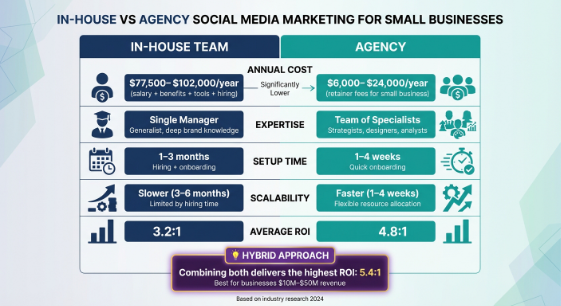
In-House vs Agency Social Media Marketing Cost and Performance Comparison
In-House vs Marketing Agency: Which Earns The Best ROI?
1. In-House Social Media Marketing
Running social media in-house means assembling your own team, usually starting with a dedicated social media manager who aligns closely with your brand. This setup gives you full control over your messaging and ensures a deep understanding of your brand’s identity.
Costs
The financial commitment for managing social media in-house goes beyond just paying a salary. In the U.S., a mid-level social media manager earns about $70,000–$72,000 per year. But when you factor in benefits, taxes, and other overhead, the actual cost jumps to roughly 1.4 times the base salary. On top of that, hiring expenses - ranging from $8,000 to $15,000 - and an average hiring process of 42 days add up quickly.
Then there’s the cost of tools. Essential platforms like Hootsuite ($99–$249/month) and Jasper.ai ($49–$125/month) bring an additional $2,000–$5,000 per year to your budget. Altogether, the first-year investment for an in-house social media setup can range from $77,500 to over $102,000.
Expertise and Tools
One of the main challenges for in-house teams is the lack of specialized expertise. While an in-house manager will have a deep understanding of your brand, they often juggle multiple roles. This can make it hard to tackle everything from strategy and content creation to audience engagement effectively. As the seoplus+ Team explains, “Implementing [strategy], plus preparing, creating, and executing your daily posts and engaging with your audience often simply becomes too much for one marketing person to handle successfully”.
"For the cost of employing one social media manager, you can retain a professional social media firm and gain access to a multiplicity of digital marketing experts." – WSI
Specialized tasks like video editing, advanced ad strategies, or data analytics often require additional training or external help. Plus, with social media platforms constantly evolving, staying updated on trends and algorithms demands ongoing investment in professional development.
Scalability
Scaling an in-house social media team can be one of its biggest hurdles. As your social media needs grow, adding new team members often takes 3–6 months, including recruitment, onboarding, and training. This delay creates a bottleneck that can limit how quickly your team can adapt to increased demands.
"An in-house social media team is a good fit when consistency matters more than scale. If your business expects faster growth... this model alone usually hits a ceiling." – Digi Growth Lab
Another challenge is burnout. A single manager handling strategy, content, community management, and analytics can easily become overwhelmed. If they leave, your entire social media strategy could come to a halt, leaving gaps that take time and effort to fill. These issues highlight why scaling an in-house team requires careful planning and foresight.
Control and Brand Understanding
Where in-house teams excel is in control and brand familiarity. A dedicated manager who’s immersed in your day-to-day operations can react quickly to company updates or industry changes. This is especially crucial for businesses in technical B2B industries, where complex products demand a nuanced understanding. According to the Content Marketing Institute, such companies see a 30% boost in content authenticity when managed internally.
However, this comes at a cost. While you gain complete control and alignment with your brand, you may lose access to the specialized skills and scalability offered by external teams. For businesses that require frequent posting (15+ posts per week) or real-time engagement, an in-house team can deliver the immediacy needed - provided you’re ready to address the resource limitations.
With these pros and cons laid out, let’s take a closer look at the alternative: agency-led social media marketing.
2. Agency Social Media Marketing
Hiring an agency gives you instant access to a team of specialists - strategists, designers, copywriters, and analysts - who collaborate to deliver results. For small businesses, this setup often means achieving more without the added costs of salaries, benefits, and training.
Costs
Agency pricing typically starts at $500–$2,000 per month for smaller needs and ranges from $2,000–$5,000 for mid-sized businesses. Additionally, expect a one-time setup fee of $500–$3,000.
When compared to building an in-house team, which includes expenses like payroll taxes, benefits, recruitment, and training, agency fees are often a more budget-friendly choice for small businesses. In fact, 68% of small businesses (1–50 employees) outsource their social media management. Agencies also include tools like advanced analytics and social listening software in their fees, potentially saving you thousands of dollars annually.
"Be weary of agencies that seem too cost-effective - you likely won't be getting social experts. So if the price seems too good to be true, it won't get you the results you're hoping for." – Lindsay Ashcraft, Social Content Lead, Later
One key tip: always keep your ad spend separate from agency management fees. This ensures transparency and helps you track exactly where your money is going.
With these cost advantages, agencies provide not only affordability but also unmatched expertise and access to premium tools.
Expertise and Tools
Agencies bring a level of specialization that a single in-house manager often can't replicate. Need a polished video for Instagram Reels? They have professional videographers. Planning a complex Facebook ad campaign? Their expert media buyers have it covered. This approach prevents over-reliance on one person.
Agencies stay ahead of the curve with premium analytics and tools, making sure your campaigns are optimized. They focus on mastering new features, algorithm changes, and trends because it's essential to their work. Professional agency management delivers an average ROI of 4.8:1, compared to 3.2:1 for in-house teams. Additionally, agencies deliver 45% better results within the first year compared to internal hires who are still learning the ropes.
"Working with an agency isn't just the work hours being allocated... it's also the tools, expertise, and knowledge. Particularly with social, it's an intersection of design, writing, storytelling, and community management." – Bowie Fan, Social Media Marketing Specialist, NVISION
Providing clear brand guidelines ensures your content remains authentic. With their combined expertise and tools, agencies can quickly adapt campaigns to meet your needs.
Scalability
When it comes to scaling, agencies are hard to beat. Whether you're launching a new product or adjusting your strategy due to budget changes, agencies can shift resources or add specialists with ease. Unlike in-house teams that may struggle with sudden growth, agencies distribute tasks across their team, ensuring smooth execution of your strategy.
For small businesses experiencing rapid growth, this flexibility is invaluable. Agencies can also help you focus on 1–2 key platforms initially, where your audience is most active, before expanding. Expanding to additional channels can increase fees by 25–40%. While engagement improvements can appear within 30 days, it usually takes 90–120 days to see meaningful lead generation and sales growth.
"The question isn't whether agencies or internal teams are objectively superior... The question is which approach best matches your company stage, strategic priorities, and capability requirements." – Sheila Kloefkorn, CEO, KEO Marketing
This scalability ensures that your social media efforts grow alongside your business.
Control and Brand Understanding
One trade-off with agencies is a slight loss of direct control. While they bring expertise and scalability, they may not be as immersed in your daily operations or company culture. This can sometimes lead to slower responses to real-time changes.
To address this, many businesses assign an in-house marketing representative to act as a bridge between the company and the agency. This person ensures brand consistency and provides important context for creating authentic content.
"Agencies can be a really great fit for those who tend to be more comfortable with loosening their own reigns of control." – Lindsay Ashcraft, Social Content Lead, Later
If your business prioritizes strategic expertise and flexibility over direct oversight, partnering with an agency could be the right move.
Pros and Cons
Here’s a quick breakdown of how in-house social media teams stack up against agencies, based on key factors:
| Criteria | In-House Social Media Team | Social Media Agency |
|---|---|---|
| Typical Cost | $32,000–$60,000+ per year (salary, benefits, & tools) | $6,000–$24,000 per year (small business retainer) |
| Expertise | Deep knowledge of the brand and product; often generalists | Access to specialists in ads, video, strategy, etc. |
| Scalability | Limited by team size and hiring time | Highly flexible; resources shift within 1–4 weeks |
| Control | High; direct oversight and close brand alignment | Moderate; governed by service agreements |
| Setup Time | 1–3 months (hiring and onboarding) | 1–4 weeks (onboarding) |
In-house teams are ideal when retaining full control over your brand voice and engaging in real-time interactions is a priority. However, the upfront costs and the time required to hire and train staff can create delays. Agencies, on the other hand, offer instant access to specialists and advanced tools without the ongoing overhead. This efficiency often translates to better returns, with agencies delivering an average ROI of 4.8:1 compared to 3.2:1 for in-house teams.
Interestingly, 68% of small businesses (1–50 employees) choose to outsource their social media management. While this means giving up some direct control, it allows them to tap into expertise they might not have in-house.
For businesses looking for the best of both worlds, a hybrid approach can be a game-changer. By combining internal brand oversight with external expertise, companies have achieved an even higher ROI of 5.4:1. This strategy offers a balance of control and scalability, making it a strong contender as your business grows.
Conclusion
Choosing between in-house and agency social media marketing comes down to where your business stands today and where you want it to go. For startups or businesses generating less than $10 million in revenue, agencies are a solid option. They can establish a strong social media presence without the risks and expenses tied to hiring full-time staff.
As your revenue grows, so will your needs. Businesses in the $10 million to $50 million range often benefit from a hybrid approach. This might involve hiring an internal coordinator to maintain your brand voice while partnering with an agency for execution and analytics. This model has proven effective, delivering an ROI of 5.4:1, while offering both control and flexibility.
For companies exceeding $50 million in revenue, the strategy evolves further. A dedicated in-house team becomes essential for real-time engagement and seamless integration, while agencies can take on specialized tasks like high-end video production or complex advertising campaigns.
"The question isn't whether agencies or internal teams are objectively superior... The question is which approach best matches your company stage, strategic priorities, and capability requirements." - Sheila Kloefkorn, CEO, KEO Marketing
Carefully evaluate costs before deciding. If your strategy demands frequent posting (15+ posts weekly) and round-the-clock community management, handling these tasks internally may save money. On the other hand, if you prioritize speed, expertise, and scalability without increasing headcount, agencies are better equipped to deliver results efficiently and with less risk.
Frequently Asked Questions
-
Hiring in-house can be more budget-friendly if the total expenses for salaries, benefits, recruitment, and training for a small team fall below what you'd pay for an agency's retainer and project fees. The actual costs will vary based on the size and complexity of your marketing efforts, so it's crucial to assess your specific requirements to figure out which option makes the most financial sense.
-
When collaborating with an agency, keep certain tasks in-house - especially those that hinge on genuine brand connection and expert-level knowledge of your business. This includes areas like thought leadership, real-time interactions with your audience, and content that demands a deep understanding of your brand. These responsibilities thrive under the care of your team, thanks to their close relationship with your brand and its unique audience.
-
To evaluate social media ROI within 90–120 days, focus on metrics that directly impact your business, such as leads generated, sales closed, or engagement quality - not superficial numbers like follower counts. Start by setting clear, actionable goals. Then, calculate your total investment, including time spent, ad spend, and tool subscriptions.
Next, assess the value your efforts bring, such as conversions or revenue generated, and apply a simple ROI formula: (Revenue - Costs) / Costs. This helps you put a concrete number on your returns.
Consistently review your data, identify what’s working, and fine-tune your strategy as needed. This approach ensures your efforts stay aligned with your overall business goals while helping you improve results over time.
