
5 Operational Signs Your Social Media Marketing Is Holding Your Business Back

Your social media strategy might be costing your business more than you think. From inconsistent posting to ignoring audience engagement, these common mistakes can hurt your brand, reduce revenue, and waste resources. Here are five clear signs your social media efforts need a revamp:
Inconsistent Posting: Irregular schedules confuse algorithms and audiences, lowering reach and engagement.
Unclear Goals: Metrics like likes and shares won’t matter if they don’t align with business outcomes like sales or leads.
Ignoring Engagement: Failing to respond to comments or messages can drive customers to competitors.
Low-Quality Content: Poor visuals or overly promotional posts signal unprofessionalism and alienate audiences.
Poor Demand Management: Sudden spikes in activity can overwhelm teams without proper systems in place.
The fix? Set clear goals, post consistently, engage with your audience, and focus on quality content. Use tools like content calendars, analytics dashboards, and response protocols to streamline your efforts. These changes can transform social media into a reliable growth driver for your business.
5 Social Media Mistakes Business Owners Keep Making
Sign 1: Inconsistent Posting Schedule
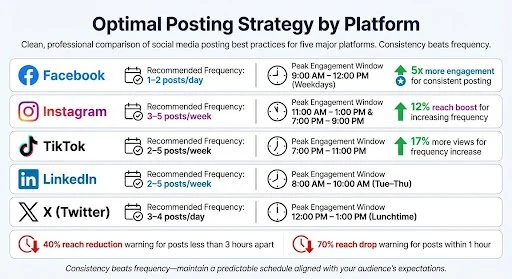
Social Media Posting Frequency and Peak Engagement Times by Platform
The Problem
An unpredictable posting schedule - like posting three times in one week, disappearing for two weeks, and then bombarding your audience with five posts in three days - can confuse both your audience and the algorithm. Social media platforms thrive on consistency. When your posting is erratic, the algorithm deprioritizes your content, which means fewer people see it. This inconsistency doesn’t just hurt engagement in the short term; it can derail your entire social media strategy.
Accounts that post consistently see significantly better results. For example, consistent accounts enjoy five times more engagement per post compared to sporadic ones. On Instagram, increasing your posting frequency from 1–2 times per week to 3–5 times can boost your reach by 12% and double your follower growth rate from 0.12% to 0.26%. On TikTok, moving from one post a week to 2–5 posts a week can increase views per post by 17%.
Inconsistency also damages your brand’s image. When your posting is irregular, your audience might perceive your brand as unreliable or disengaged - exactly the opposite of what you want.
"Consistency builds recognition. Recognition builds trust. Trust drives action." - Kathlyn Angeles-Timbol, Social Speak Network
Posting too frequently in short bursts can also backfire. If you publish posts less than three hours apart, they end up competing with each other. This can reduce the reach of the second post by 40%, and if you post within an hour, the reach can drop by as much as 70%. To regain traction with both your audience and the algorithm, addressing these inconsistencies is crucial.
The Solution: Use Content Calendars and Scheduling Tools
The goal isn’t to post every single day - it’s to post predictably. A steady rhythm that aligns with your audience’s expectations and the algorithm’s preferences is far more effective than sporadic bursts of activity. For example, two to three well-planned posts per week consistently outperform daily posts followed by weeks of silence.
To make this happen, dedicate 1–2 days a month to batch-creating content. Aim for 40–60 pieces of content during this time to ensure you always have material ready, even during busy periods. This eliminates the stress of last-minute posting.
Leverage scheduling tools to maintain a consistent presence, especially during peak engagement periods or when your team is stretched thin. Posting during times when your audience is most active is key - early engagement (likes and comments in the first hour) signals quality to the algorithm, which can boost your content’s visibility over time.
"Timing and frequency can help, but they aren't the end-all-be-all... The content itself will always be the most important factor." - Christie Osterhus, Loomly
Here’s a quick guide to recommended posting frequencies and peak engagement times:
| Platform | Recommended Frequency | Peak Engagement Window |
|---|---|---|
| 1–2 posts/day | 9:00 AM – 12:00 PM (Weekdays) | |
| 3–5 posts/week | 11:00 AM – 1:00 PM & 7:00 PM – 9:00 PM | |
| TikTok | 2–5 posts/week | 7:00 PM – 11:00 PM |
| 2–5 posts/week | 8:00 AM – 10:00 AM (Tue–Thu) | |
| X (Twitter) | 3–4 posts/day | 12:00 PM – 1:00 PM (Lunchtime) |
To maximize efficiency, repurpose your content across different formats. For instance, a single blog post can be transformed into a short video, a carousel post, or a quote graphic. This approach allows you to fill your calendar without constantly creating new material. By sticking to a consistent schedule and diversifying your content, you can achieve 47% more reach and three times more engagement.
Sign 2: Unclear or Misaligned Goals
The Problem
Having impressive social media metrics is great, but if those numbers aren't driving meaningful business results, there's a disconnect. According to research, 47% of social media marketers say their biggest challenge is creating strategies that align with overall business goals.
You might have posts that rack up likes and shares, but if someone asks how that viral content contributed to revenue or lead generation, you might struggle to answer. This gap often leads to focusing on vanity metrics - numbers that look good but don’t translate into actual value.
"Likes don't equal revenue." - Mike Allton, Director of Partner-led Growth, Agorapulse
When social media goals exist in isolation, they can attract audiences who aren’t genuinely interested in your product or service. Worse, you might end up wasting time and resources managing too many platforms without seeing a return. The key is to set goals that directly connect to your business outcomes.
The Solution: Set SMART Goals That Match Your Business Objectives
The first step? Use SMART goals - Specific, Measurable, Achievable, Relevant, and Time-bound. Instead of a vague aim like "increase brand awareness", try something more defined: "Increase Instagram reach by 25% among women aged 25-34 within three months by posting educational content three times per week." This approach gives you a clear target to track and achieve.
"Demonstrating how social media campaigns are tied to business goals is the #1 way social teams can secure more investment from leadership." - Sprout Social
You should also align your social media metrics with specific business objectives. For example, if your goal is to raise brand awareness, focus on metrics like reach and impressions. If your aim is lead generation, track lead form submissions or content downloads. Here's a quick breakdown:
| Campaign Tier | Estimated Ad Spend | Primary Platforms | Typical Deliverables |
|---|---|---|---|
| Low-Budget | $500 – $2,000 | TikTok, Instagram Reels | Short-form, DIY-style clips |
| Mid-Tier | $2,000 – $10,000 | Facebook, YouTube, LinkedIn | Professional product demos, testimonials |
| High-End | $10,000 – $50,000+ | Multi-channel, TV, Global | Cinematic ads, influencer collaborations |
To get the most out of your budget, negotiate for extras like multiple aspect ratios, varied calls-to-action, and access to raw files. These additions can help with version testing and future campaigns. Using AI tools to automate video formatting can also reduce costs when adapting content for different platforms. Finally, always keep a 10–15% contingency fund for unexpected expenses or additional revisions.
How to Budget for Video Marketing
Start by setting clear KPIs that align with your goals. Are you aiming to generate leads, boost brand awareness, or drive conversions? Your objectives will determine the type of videos you create and the budget you’ll need to allocate. This step ensures your spending is purposeful and effective across all stages of production.
A practical way to distribute your budget is by dividing it among the key production phases. Typically, allocate 20–30% for pre-production (activities like scripting, planning, and casting), 40–50% for production (filming, crew, and equipment), and 25–30% for post-production (editing, sound design, and color grading). While it might be tempting to cut costs, choosing the cheapest option can backfire - low-quality videos can harm your brand image and deter potential customers.
Another factor to consider is the long-term value of your investment. For instance, a professionally produced video costing $25,000, used consistently over three years, breaks down to about $700 per month. This can often be more economical than running ongoing SEO campaigns or paid advertisements. Thinking about costs in this way can make a higher upfront investment easier to justify, especially for content designed to stay relevant over time.
"Smart video pricing goes beyond covering expenses. It's about proving that the right spend leads to measurable ROI and long-term business results." – Liza Burke, Marketing Director, Levitate Media
Working with agencies like Burt's Media can also optimize your budget. Agencies often create reusable asset banks - like motion graphics, B-roll libraries, and templates - that can cut future project costs by 30–40%. They also streamline production by batching multiple videos into single shoot days, reducing expenses for crew and equipment.
Scaling Your Video Marketing Budget
As your business grows, your video marketing budget should expand accordingly. For startups with annual revenue under $1 million, budgets typically range from $3,000 to $10,000. At this stage, focus on foundational content like social media clips, testimonials, or training videos. To maximize your spending, consider filming multiple videos in one session.
For businesses earning $1 million to $10 million annually, video investments usually increase to $10,000–$25,000. This level allows for professional storytelling, product launch videos, and polished explainers. A smart strategy here is to repurpose assets: a single shoot can produce a homepage video, social media clips, and other content, delivering more value from your initial spend.
Established companies with revenue exceeding $10 million often allocate $25,000–$100,000 or more for cinematic productions, multi-market campaigns, and advanced visual effects. Subscription-based models are worth considering at this stage, as they provide predictable monthly costs and allow for continuous content creation.
Here’s a snapshot of typical monthly budgets across different growth stages:
| Business Objective | Social Media Metric to Track |
|---|---|
| Raising Brand Awareness | Reach, Impressions, Social Mentions |
| Generating Leads | Lead Form Submissions, Gated Content Downloads |
| Increasing Web Traffic | Click-Through Rate (CTR), Network Referrals |
| Boosting Sales/Revenue | Conversion Rate, Social Media ROI, Sign-ups |
| Improving Customer Care | Response Time, Customer Satisfaction Score (CSAT) |
To stay on track, document your strategy and review it regularly. Weekly check-ins and monthly reports can help you identify what’s working and what needs adjustment. Instead of spreading your efforts thin across every social platform, focus on the top two platforms where your audience is most engaged. This ensures that your time and budget are directly contributing to your business growth.
Sign 3: Ignoring Audience Engagement
The Problem
Posting content without responding to comments or messages? That’s a missed opportunity. Social media isn’t just a megaphone to broadcast your message - it’s a conversation. And when you ignore your audience, people notice. That silence? It sends a loud message.
Here’s what happens when engagement is neglected: 73% of users switch to competitors when they feel ignored. Worse, it can amplify negative feedback. Even algorithms pick up on the inactivity, reducing your organic reach.
"The problem with being online is that the world is watching you, so any negative experiences are right there for others to observe."
Terry Ellis, h2o digital
But it’s not just about reputation. When you don’t engage, you lose a key opportunity to turn awareness into revenue. Take CBIZ, for example. Between 2019 and 2025, they shifted from static posts to a more interactive LinkedIn strategy. The result? A 67% jump in engagement and $800,000 in revenue directly tied to social media efforts.
Engagement also drives customer loyalty. Responding to customers can lead to them spending 20% to 40% more with your brand. And here’s a big one: 65% of customers reach out on social media with questions before making a purchase. Ignoring them isn’t just bad etiquette - it’s bad business.
The Solution: Create Response Protocols and Team Guidelines
Responding to your audience should be a priority. Why? Because 73% of consumers expect a reply within 24 hours or less. To meet this expectation, you need a clear and consistent engagement strategy.
Start by creating a response matrix. This tool helps your team handle different types of feedback - whether it’s positive, neutral, or negative. Using a unified inbox tool can also help you manage messages across multiple platforms, ensuring nothing gets missed. For example, Sprout Social reduced their average response time by 55% within three months after centralizing their messaging system in 2024.
Next, document your brand voice and establish escalation procedures. This ensures that team members know how to respond and when to involve managers or specialists. JetBlue Airways does this well by dividing responsibilities among three teams - marketing, communications, and customer commitment - allowing them to engage playfully while addressing technical issues. While you may not need multiple teams, defining roles is crucial.
Finally, track your efforts. Monitor metrics like response time, resolution rates, and customer satisfaction to identify areas for improvement. PNC Bank took a proactive approach in early 2024, reaching out to customers before being tagged. This strategy resulted in a 64% positive sentiment rate, outperforming competitors by 8% to 12%.
Engaging with your audience isn’t just about keeping up appearances - it’s about building trust, improving customer experiences, and creating a seamless social media strategy that drives results.
Sign 4: Low-Quality Content and Inefficient Strategies
The Problem
Low-quality content can harm your brand’s reputation. If your social media feed is visually inconsistent, it sends mixed messages to your audience and makes your business seem unprofessional. Similarly, generic messaging fails to resonate.
The stats are clear: educational and entertaining content generates 66% more engagement than posts that are purely promotional. Despite this, many businesses continue to overwhelm their followers with constant sales pitches. To build trust, only 10% of your social media content should focus on direct promotion. Exceeding this can alienate your audience.
"Data isn't the enemy of creativity. It's how creativity wins."
Rachel Davis, Partner, Matchstick Social
A mismatch between a high follower count and low engagement is a clear red flag - your content isn’t connecting. If video analytics show viewers dropping off after the first few seconds, it’s a sign your content isn’t holding their attention. And when you post the same type of content across all platforms - like sharing professional articles on TikTok - you’re failing to adapt to each platform’s strengths.
Inefficiency in content creation also takes its toll. 52% of marketers struggle to find skilled social media professionals, and 49% say that staying on top of trends is one of their biggest challenges. These hurdles become even harder to overcome when businesses waste time creating new content for every post instead of repurposing successful material strategically. With expert guidance, these issues can be turned into opportunities.
The Solution: Work with Content Strategy Experts like Burt's Media
Creating high-quality content requires a team that knows what they’re doing. That’s where professionals like Burt's Media step in. They specialize in crafting content strategies tailored to your business goals, offering services like video production, photography, social media management, and strategy development.
Start with a content audit to identify which posts are driving the most engagement and which ones are falling flat. This helps uncover trends in what your audience responds to. From there, establish 3–5 content pillars - key themes that will guide your posts and create consistency. For example, focus on education, entertainment, inspiration, and promotion, using the 70/20/10 rule: 70% of your content should provide value (educational or entertaining), 20% can be curated from other sources, and only 10% should be promotional.
It’s also important to customize content for each platform instead of recycling the same material everywhere. Concentrate your efforts on 2–3 platforms where your target audience is most active, rather than trying to maintain a presence on every channel.
"If you can't articulate the value of a post in one sentence, don't publish it."
Matchstick Social
Sign 5: Poor Management of Demand Spikes and Metrics
After tackling content quality and engagement, there's another critical factor to address: how well your team handles sudden demand spikes and interprets key metrics.
When your social media activity surges - whether due to a viral post, a campaign, or a product launch - your team needs to be prepared to handle the influx of comments, DMs, and mentions. Unfortunately, many businesses fall short here. They lack the systems to scale their workflows, resulting in missed opportunities.
The statistics are telling: 59% of creators experience burnout from the relentless need to produce content. On the flip side, 73% of consumers are willing to switch to a competitor if their inquiries on social media go unanswered. When demand spikes hit, businesses without scalable strategies often fail, leading to frustrated customers and lost revenue.
But it’s not just about managing volume. Many businesses focus on vanity metrics like follower counts and likes while overlooking more actionable data, such as engagement quality, response times, or conversion rates. Without these insights, you can’t differentiate between a PR crisis and a wave of positive buzz.
"A messy social media workflow costs you more than time. It drains creativity, creates bottlenecks, and makes proving results nearly impossible."
Sabina Varga, Content Marketing Expert
And with 45% of consumers unfollowing brands that post unhelpful or repetitive content, inefficient workflows can quickly derail your efforts when you should be doubling down on what’s working.
The Solution: Use Analytics Dashboards and Scalable Workflows
To thrive during demand surges, you need systems that adapt quickly to increased activity - and help you capitalize on the momentum.
Start by improving visibility. Centralized analytics dashboards like Buffer, Socialinsider, or Brandwatch allow you to monitor all your social platforms in real time. Focus on metrics that provide actionable insights, such as engagement quality (saves, shares, and comments), average response time, and click-through rates, rather than just likes or follower counts.
Develop a response protocol to prioritize customer inquiries and complaints immediately, while handling lower-priority interactions later. This ensures you’re addressing what matters most during high-demand periods.
For content creation, adopt batching workflows. For example, film videos for two weeks in a single session or write captions for an entire week in one sitting. This method minimizes the mental exhaustion of constant multitasking while maintaining consistency during busy times. Using content pillars and templates can also streamline production without sacrificing quality.
"Any tool that can save myself or one of my analysts time and brain space, I'm a big fan of."
Riley, Think Jam
Automation is another key component. Set up auto-responders for FAQs, schedule content weeks in advance, and use analytics tools to monitor sentiment spikes. This way, you can quickly determine whether a surge in mentions signals positive momentum or an issue requiring immediate action. By automating repetitive tasks and centralizing your data, you create a strategy that’s both efficient and scalable. With the right systems in place, scaling up doesn’t have to mean burning out - it means seizing opportunities that might otherwise slip through the cracks.
Conclusion
If you've spotted operational gaps in your social media strategy, now's the time to take action and make meaningful changes.
Your social media efforts should fuel growth, not hold it back. Issues like irregular posting, lack of clear objectives, ignoring audience engagement, poor content quality, or weak metrics tracking can cost you valuable opportunities. Consider this: 91% of people visit a brand's website or app after following them on social media, and 89% make a purchase. Without addressing these problems, you're missing out on this potential.
Fixing these five key issues with a strategy rooted in data can turn your social media presence into a powerful tool for growth. The shift lies in moving away from reactive approaches and embracing a thoughtful, data-backed plan.
"Social media success isn't about going viral or having millions of followers. It's about building genuine relationships with your ideal customers, providing value consistently, and guiding those relationships toward business outcomes."
Consistent efforts on social media can lead to measurable results within 6–12 months. Focus your energy on 1–2 platforms where your audience is most active, apply the 80/20 rule (80% value-driven content, 20% promotional), and prioritize metrics like engagement quality and conversion rates over follower counts.
Looking to close these operational gaps? Burt's Media specializes in crafting content strategies that align with business goals. From video production and social media management to paid advertising, we help businesses build scalable systems that turn followers into loyal customers.
Frequently Asked Questions
-
To find the best one or two social platforms for your business, start by identifying where your target audience is most active and how those platforms align with your goals. Look into audience demographics and behaviors - LinkedIn is ideal for B2B connections, while Instagram is perfect for brands relying on visual appeal. Focus on platforms where your customers are already spending their time. This way, you’ll avoid stretching your resources too thin, allowing you to create stronger content, build engagement, and track results more effectively.
-
Metrics that show a clear return on investment (ROI) include conversions, sales, revenue, customer acquisition, and actions such as email sign-ups. These numbers tie your social media efforts directly to tangible business results, giving you a clear picture of their effectiveness.
-
When a post takes off and gains widespread attention, keep a close eye on the engagement it generates. Pay attention to the tone and nature of the responses. Be quick to address questions, concerns, or any negative feedback - this helps you manage the situation effectively and avoid it spiraling out of control. Use what you learn from the reactions to adjust and improve your approach moving forward.
If the attention is positive, use this opportunity to interact in a genuine way. This can help you turn the moment into a foundation for building lasting relationships. On the flip side, if the post sparks negative publicity, revisit your crisis management plan and focus on actions that can rebuild trust and repair your reputation.
