
Social Media Management: In-House vs Agency

Managing social media effectively is more complex than ever, requiring skills like content creation, paid ads expertise, and analytics. Businesses face a key decision: build an in-house team or hire an agency. Here's the quick breakdown:
In-House Teams: Offer direct brand control and faster responses but come with high costs (up to $550,000/year for a full team) and limited scalability.
Agencies: Provide access to specialists, higher content output (40–60 pieces/month), and better ROI (4.8:1) but may lack deep brand familiarity and involve less control.
Hybrid Model: Combines in-house oversight with agency expertise, delivering the best ROI (5.4:1) and balancing control with efficiency.
Quick Comparison:
| Factor | In-House Management | Agency Management |
|---|---|---|
| Brand Control | High | Moderate |
| Cost | $450,000–$550,000/year | $4,000–$8,000/month |
| Content Output | 15–25 pieces/month | 40–60 pieces/month |
| Average ROI | 3.2:1 | 4.8:1 |
| Scalability | Limited | High |
Your choice depends on budget, content needs, and how much control you want over your brand’s voice. For many, a hybrid approach offers the best balance of cost, output, and flexibility.
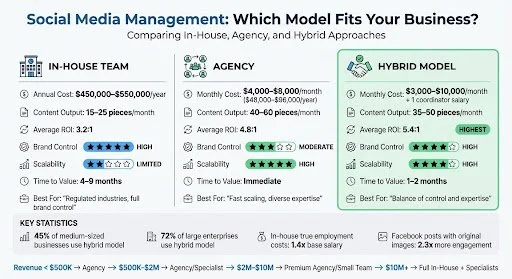
In-House vs Agency Social Media Management: Cost, ROI, and Output Comparison
In-House vs Agency Marketing, How to Align Both for Maximum Growth
In-House Social Media Management: Pros and Cons
Building an in-house social media team means hiring employees who are solely focused on your company’s social presence. These individuals become deeply embedded in your organization, managing everything from daily posts to interacting with your audience. While this setup offers some clear advantages, it also comes with hidden costs that are worth considering.
Benefits of Managing Social Media In-House
One of the biggest perks of having an in-house team is the ability to maintain a consistent and genuine brand voice. Employees who are immersed in your company’s culture can naturally reflect its tone and personality in a way that’s hard for outsiders to match. As StringCan Interactive puts it:
The vibe of your company's culture and the voice of your brand is something that is nearly impossible for someone outside your business to replicate, even if you describe it to them.
Another advantage is instant access to original content. On-site social media managers can capture behind-the-scenes moments, live events, or team celebrations as they happen. This type of real-time content resonates with audiences - Facebook posts with original images, for example, see 2.3 times more engagement than those without.
Speed is also a key benefit. When breaking news occurs or urgent feedback needs addressing, an in-house manager can respond right away, avoiding delays caused by agency approval processes. Lindsay Ashcraft, Social Content Lead at Later, highlights this:
Internal social media managers have a leg up on time spent on briefs and processes. And given their level of authority and autonomy, in-house talent can more quickly react to changes or breaking news in the industry.
Additionally, managing social media internally gives you complete control over messaging and strategy. This is especially important in industries like finance or healthcare, where compliance and accuracy are critical. Being in-house also means closer collaboration with teams like sales or customer support, allowing for smoother, more integrated campaigns.
However, before committing to an in-house setup, it’s important to weigh the costs involved.
What In-House Teams Cost
The financial investment for an in-house team goes well beyond just salaries. In the U.S., a social media manager typically earns between $60,000 and $90,000 annually, with the average being around $72,000. Add in benefits like health insurance, retirement plans, paid time off, and payroll taxes, and you’re looking at an additional 20% to 40% on top of base salaries. Recruitment costs alone can range from $8,000 to $15,000 per hire.
Then there’s the cost of tools. Enterprise-level analytics, scheduling platforms, and design software can cost at least $3,000 annually. For mid-sized teams, this can climb to over $50,000 per year.
New hires also take time to become fully productive. It often takes 3–6 months for a social media manager to hit their stride, which means you’re paying full salary for reduced output during this period. Sheila Kloefkorn, CEO of KEO Marketing, explains:
True employment costs average 1.4x base salaries when accounting for benefits, taxes, technology, training, and management overhead that most budget comparisons ignore completely.
If your business requires a full team - say, a manager, content creator, analyst, and specialist - annual costs can range from $450,000 to $550,000. For many companies, this level of investment is substantial.
Beyond the financial aspect, there are operational hurdles that can affect the efficiency of in-house teams.
Common Problems with In-House Teams
One major challenge is skill gaps. Social media management isn’t just about posting - it requires expertise in areas like video editing, graphic design, copywriting, paid advertising, and data analysis. Finding one person with all these skills is rare, and hiring multiple specialists can quickly become expensive.
This often leads to reduced content output. An in-house manager typically produces 15–25 pieces of content per month, while agencies can deliver 40–60 pieces in the same timeframe.
Burnout is another risk. Amanda Demeku from Later warns:
A solo in-house social media manager will have limited bandwidth and tools compared to an agency. As a result, setting realistic expectations is crucial to prevent the risk of burnout.
When one person is juggling strategy, content creation, community management, and reporting, quality can take a hit.
Keeping up with constantly changing platform algorithms is another challenge. Nearly half of marketers (49%) cite algorithm updates as a top concern. Without exposure to diverse industries, in-house teams can develop tunnel vision, missing broader trends.
Lastly, there’s the issue of “unlimited access.” Stakeholders often assume in-house teams are always available, leading to poorly prioritized tasks and inefficiencies. Without clear boundaries, social media managers can become overwhelmed with non-essential requests, pulling focus away from core responsibilities.
Agency Social Media Management: Pros and Cons
Deciding between an in-house team or an agency for social media management involves weighing the strengths and weaknesses of each approach. Agencies bring a team of specialists and access to advanced tools, but they also require some trade-offs, like reduced control. Let’s break down what agencies can offer and where they might fall short to help you determine if this option aligns with your business needs.
Access to Specialists and Tools
One of the biggest perks of hiring an agency is the access to a team of experts. Instead of relying on one person to handle everything - strategy, design, copywriting, and analytics - agencies provide specialists for each role. This division of labor allows them to produce more content, typically 40–60 pieces per month, compared to the 15–25 pieces an in-house manager might deliver.
Agencies also come with a suite of tools that would otherwise cost your business a significant amount. Software like Sprout Social, SocialPilot, and enterprise analytics platforms are included in agency retainers, saving you from additional subscriptions. Beyond software, agencies offer resources like stock photo libraries, video editing suites, and AI scheduling tools, which 78% of businesses now use to optimize their social media efforts.
Another standout benefit is the ability to scale quickly. Whether you’re launching a new product or running a major campaign, agencies can ramp up resources without the delays of hiring and training new staff. As Jordan Scheltgen, Founder of Cave Social, puts it:
Think of a boutique agency as an extension of your team. They integrate seamlessly into your operations, providing the consistency and alignment you'd expect from an in-house manager with the added benefit of diverse expertise.
Additionally, since agencies work across various industries and clients, they tend to notice platform trends and algorithm changes faster than internal teams. All these factors make agencies a compelling option for businesses looking to maximize their social media presence.
Agency Pricing and Returns
The expertise and tools agencies provide come with structured pricing models. Most agencies charge monthly retainers, offering predictable costs and steady service. Pricing usually falls into three tiers based on the size of your business and your needs:
| Client Tier | Monthly Retainer | Deliverables |
|---|---|---|
| Small Business | $500 – $2,000 | 2-3 platforms, 8-20 posts, basic monitoring |
| Mid-Market | $2,000 – $5,000 | 3-5 platforms, 20-40 posts, strategy, ads, reporting |
| Enterprise | $5,000 – $20,000+ | All platforms, 40+ posts, dedicated team, crisis management |
Some agencies charge a percentage of your ad spend - typically 15–25% - with a minimum fee to ensure profitability. Others use hybrid pricing, combining a base retainer with performance bonuses (around 10–20%) for hitting specific goals like lead generation or engagement growth.
Expect an upfront setup fee of $500–$3,000 to cover brand immersion, strategy development, and tool integration. While this initial cost might seem steep, it often delivers results: professional agency management averages a 4.8:1 ROI ($4.80 return for every $1 spent), compared to 3.2:1 for in-house teams.
Keep in mind that it can take 30–90 days to see early engagement improvements, while full ROI and measurable sales impact may require 6–12 months of ongoing strategy adjustments. Some agencies even offer performance guarantees, such as a 25% increase in leads within 90 days, but these promises should be evaluated carefully.
Potential Drawbacks of Working with Agencies
Despite their advantages, agencies aren’t without challenges. One common issue is the balancing act agencies face with multiple clients. This can sometimes make your brand feel like just another account. Unlike in-house managers who dedicate all their focus to your company, agencies must juggle priorities across their client base. This can lead to generic or "cookie-cutter" content that lacks your brand’s unique voice.
Another hurdle is capturing your company’s personality and culture. Agencies may struggle to fully understand your brand at first, leading to content that feels off-brand or impersonal. While a thorough onboarding process can help, it takes time for external teams to grasp the nuances that set your business apart.
Working with an agency also means giving up some control. If you prefer to approve every post or make quick adjustments, you might find the longer communication loops with agencies frustrating. They may also be slower to respond to breaking news or real-time opportunities.
Lastly, watch out for hidden costs. High-end video production or advanced advertising services might come with additional fees not covered in your base retainer. Be sure to clarify what’s included upfront and limit revision rounds - typically two - to avoid scope creep and unexpected expenses.
Using Both In-House Staff and Agency Support
Pairing an internal team member with agency support - a hybrid model - can deliver outstanding results. On average, this approach achieves a ROI of 5.4:1, outperforming the 3.2:1 ROI from purely in-house teams and the 4.8:1 ROI seen with agency-only setups. It's no surprise that 45% of medium-sized businesses (50–200 employees) and 72% of large enterprises have embraced this model.
This strategy combines the best of both worlds, addressing the weaknesses of each approach. It helps avoid "solo manager burnout", where one person juggles roles like designer, copywriter, and analyst. By strategically leveraging the strengths of both in-house and agency teams, you can create a dynamic, efficient workflow.
Combining Brand Knowledge with Outside Skills
The hybrid model works by assigning tasks to the team best suited for them. Internal teams take charge of areas requiring deep brand understanding, such as maintaining the brand voice, managing stakeholder approvals, handling customer inquiries, and responding to reactive opportunities like trending topics or breaking news. Meanwhile, agencies focus on high-volume content creation, technical expertise, strategic planning, and data-driven analytics.
This division of labor introduces fresh perspectives. Internal teams, while deeply immersed in the brand, may sometimes miss emerging trends - something agencies, with their broader cross-industry experience, are well-equipped to identify.
Managing Budgets and Workload
From a financial perspective, the hybrid model offers a balanced approach to managing costs and workload. It reduces fixed in-house expenses by pairing a lower-cost internal coordinator with an agency retainer, typically ranging from $3,000 to $10,000 per month. This setup not only improves overall efficiency but also ensures flexibility.
For example, agencies can handle high-pressure periods like product launches or seasonal campaigns, while your internal team maintains day-to-day operations during quieter times.
To make this model work, invest in comprehensive agency onboarding. Lindsay Ashcraft, Social Content Lead at Later, emphasizes the importance of early-stage support:
Either way you slice it, you'll need to offer plenty of support in the beginning to be set up for success.
Ensure the agency has a solid grasp of your brand, clear approval processes, and well-defined priorities. This will help maintain consistency and ensure their work aligns seamlessly with your brand’s identity.
In-House vs Agency: Side-by-Side Comparison
Let’s break down the key differences between managing your social presence in-house versus hiring an agency. Both options affect your budget, flexibility, and ability to scale, but the right choice depends on your unique needs, financial situation, and future plans.
If maintaining full control over your brand and having the ability to respond quickly is your priority, an in-house team might be the way to go. On the other hand, if you’re looking for flexibility, access to specialized skills, and the ability to scale quickly, an agency could be a better fit. Neither is inherently "better" - it’s all about what aligns with your goals. The table below highlights these differences to help guide your decision.
Comparison Table
| Factor | In-House Management | Agency Management |
|---|---|---|
| Brand Control | High - direct oversight of every post and decision | Moderate - requires clear onboarding and approval processes |
| Cost Structure | Fixed (salaries, benefits, taxes) - around 1.4x base salary when fully accounted for | Variable/Fixed retainer ($650–$25,000/month based on scope) |
| Scalability | Limited - new hires needed, taking 4–9 months to reach full productivity | High - agencies can quickly allocate resources and specialists |
| Expertise | Limited to 1–2 skillsets; often a generalist approach | Includes 3–5 specialists (strategists, creators, analysts) |
| Content Output | Lower - typically 15–25 pieces per month | Higher - typically 40–60 pieces per month |
| Performance Metrics | Internal reporting - requires tools you purchase ($3,000–$5,000+ annually) | Advanced analytics included - agencies provide premium tools at no extra cost |
| Average ROI | 3.2:1 | 4.8:1 |
| Hidden Costs | Recruitment ($8,000–$15,000), onboarding, training, tech subscriptions | None - all costs are included in the retainer |
| Time to Value | 4–9 months for new hires to become fully effective | Immediate - agencies deliver results from day one |
From the table, it’s clear that agencies often bring higher ROI and greater content output, while in-house teams excel in maintaining brand control and adapting quickly to internal changes. Your choice should reflect what matters most to your business.
How to Choose the Right Option for Your Business
Deciding on the best approach to fit your business needs starts with looking at your revenue and available resources. Here's a general guideline:
If your annual revenue is under $500,000, it's usually more cost-effective to go with a lean solution, such as automation tools or a small agency.
For businesses earning between $500,000 and $2 million annually, a mid-tier agency or hiring a single in-house specialist can work well.
Companies with revenues between $2 million and $10 million might benefit from a premium agency or building a small internal team.
If your revenue exceeds $10 million, consider creating a full in-house team, supplemented by specialist agency partners for additional expertise.
Once you've considered revenue, think about your content output needs. For businesses publishing over 15 pieces of content weekly, dedicated resources are essential. Agencies, for instance, can produce 40–60 pieces each month, while a solo in-house hire typically handles just 15–25. Keep in mind, a single hire may struggle to effectively manage multiple platforms.
Another key factor is your willingness to delegate control. If you prefer to retain full oversight, hiring in-house will help avoid potential friction with an external agency. On the other hand, if you're comfortable outsourcing management, agencies offer specialized skills without the added costs of hiring, benefits, and training - expenses that can average 1.4 times a base salary.
Industry compliance is another critical consideration. Businesses in regulated sectors like finance, healthcare, legal, or gaming often lean toward in-house teams to ensure adherence to strict guidelines. Similarly, technical B2B companies have reported achieving 30% better content authenticity with in-house teams.
For a balanced approach, the hybrid model is worth exploring. This setup pairs an internal coordinator who maintains the brand's voice with an agency that handles high-volume content production. Notably, this model delivers a 5.4:1 ROI, giving you control over key aspects while leveraging external expertise for efficiency.
Frequently Asked Questions
-
In-house teams excel at tasks that demand an intimate understanding of the brand, such as producing content that embodies the company’s culture and values. They’re also great for working closely with other departments, enabling faster collaboration and coordination.
On the other hand, agencies are perfect for more specialized work. This includes strategic planning, creating platform-specific content, managing paid advertising, analyzing performance data, and scaling campaigns. With their broad expertise across various platforms, agencies step in when internal teams lack the necessary resources or skills.
-
To figure out the ROI of in-house, agency, or hybrid social media management, start by comparing total costs with measurable outcomes. For in-house teams, costs include salaries, benefits, training, and tools. For agencies, you'll need to account for their fees. Don’t forget to factor in hidden expenses and opportunity costs - like the time or resources you could have spent elsewhere.
Next, track key performance indicators (KPIs) such as engagement rates, leads, conversions, or sales. These metrics will help you gauge how effective your investment is. Beyond just financial returns, think about the broader strategic value - like brand visibility or audience growth - when deciding which approach works best for your goals.
-
To steer clear of surprises in an agency contract, it's important to ask the right questions upfront. This helps clarify the scope, responsibilities, and terms. Here are some key areas to focus on:
Scope of work and deliverables: What exactly is included, and what can you expect to receive? Understanding this avoids confusion about what the agency will or won't handle.
Contract length and commitments: Is there a fixed duration or any minimum obligations? Knowing this ensures you're aware of how long you're tied to the agreement.
Costs and billing practices: What are the fees, and how will billing be handled? Transparency here helps you plan your budget and avoid unexpected charges.
Team members: Who will actually be working on your account? It's good to know who you'll be collaborating with and their level of expertise.
Performance reporting: How will results and progress be communicated? Clear reporting methods ensure you're kept in the loop.
These questions help set clear expectations and foster a transparent working relationship.
