
10 Video Marketing Tips to Boost Brand Awareness
Video marketing is one of the most effective ways to grow your brand in 2026. With 93% of marketers reporting that videos improve brand awareness, it’s clear that this format is a must-have in your strategy. Short-form videos under 60 seconds dominate platforms like TikTok, Instagram Reels, and YouTube Shorts, while storytelling and user-generated content help build trust and emotional connections with audiences. Here’s a quick breakdown of the key strategies:
Short-form videos: Keep them under 60 seconds for maximum engagement.
Storytelling: Use narratives to create emotional connections.
SEO optimization: Add keywords to titles, descriptions, and captions to boost discoverability.
Grab attention fast: Hook viewers in the first 3 seconds.
Interactive features: Add polls, quizzes, or shoppable links to engage viewers.
Vertical videos: Use 9:16 formats for mobile-first platforms.
Track performance: Use tools like Vidyard or Wistia to analyze engagement and refine your approach.
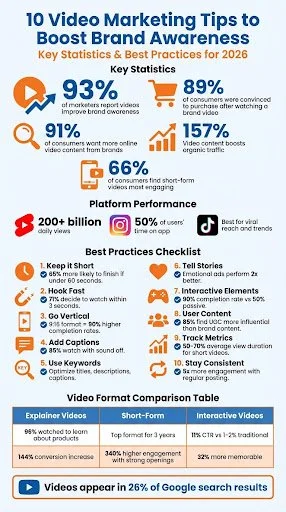
Video Marketing Statistics and Best Practices 2026
Copy this video strategy if you want MORE clients in 2026 (Full Guide)
1. Make Short-Form Videos for TikTok, Instagram Reels, and YouTube Shorts

Short-form videos have held their spot as the top-performing marketing format for three years in a row. Platforms like TikTok, Instagram Reels, and YouTube Shorts dominate when it comes to discovery, with 66% of consumers finding them the most engaging. Just consider the numbers: YouTube Shorts racks up over 200 billion daily views, while Instagram Reels accounts for 50% of users' time spent on the app.
What makes short-form videos so effective? Social platforms prioritize them because they drive high engagement, which signals value. This means your content can reach larger audiences organically - no need for extra ad spend. Plus, the vertical 9:16 format fills the entire mobile screen, grabbing attention more effectively than horizontal videos. And here’s a key stat: 65% of viewers are more likely to finish a business video if it’s under 60 seconds. That’s a huge win for delivering your message.
Each platform brings something unique to the table. TikTok is unbeatable for viral reach and jumping on trends, making it perfect for discovery. Instagram Reels shines when it comes to polished brand storytelling and tapping into Instagram’s shopping features. Meanwhile, YouTube Shorts acts as a search engine, helping drive viewers to your longer content.
A great example of this strategy in action is beauty brand Glossier. They nailed short-form content with an 80/20 approach: 80% original content (like their "Dew it Yourself" series and "Meet the Team" features) and 20% trend-focused videos. Under the leadership of Jamie Dinar, Senior Manager of Social Media and Digital, this strategy earned them over 8 million likes and nearly 500,000 followers.
"It was a lot of testing and learning, and a lot of time scrolling through my own For You Feed." – Jamie Dinar, Senior Manager of Social Media and Digital, Glossier
To create effective short-form videos, make sure to shoot in vertical 1080x1920 resolution, keep them between 15 and 60 seconds, and avoid watermarks when cross-posting. Also, design for sound-off viewing by using clear captions.
2. Use Storytelling to Connect with Your Audience
Storytelling transforms videos into compelling narratives that stick with viewers. Instead of just listing features, stories tap into emotions, creating a connection that lasts. Research shows that ads with emotional content perform twice as well as those focused solely on facts, and a whopping 92% of consumers prefer advertisements told as stories. This approach works hand in hand with broader video marketing efforts to amplify brand awareness.
Humans are naturally wired to process stories better than data. As Yuval Noah Harari famously said:
"Homo sapiens is a storytelling animal that thinks in stories rather than in numbers or graphs".
By structuring your video around a hero - whether that’s a customer, founder, or community member - facing a challenge and undergoing a transformation, you’re speaking directly to the brain’s natural preference for narratives. This method keeps viewers hooked and inspires action.
Take Nike’s "Dream Crazy" campaign from September 2018, featuring Colin Kaepernick. Instead of showcasing products, the ad shared stories of athletes breaking barriers, which led to a 31% spike in online sales shortly after its release. Similarly, General Electric’s "What’s the Matter with Owen?" campaign used sitcom-style storytelling to highlight a young programmer’s industrial job. The result? A 66% increase in job applications.
To apply storytelling effectively in your videos, start with a strong hook within the first 5-10 seconds. Introduce stakes or tension midway and weave in emotions that viewers can relate to. Use visuals - like dynamic camera angles, colors, and graphics - to carry the story, rather than relying heavily on voiceovers. Featuring real employees or founders can make your brand feel more human and trustworthy. Keep videos under 60 seconds to hold attention.
3. Add Keywords to Video Titles, Descriptions, and Captions
Optimizing your video metadata is a game-changer when it comes to connecting with the right audience. By fine-tuning elements like titles, descriptions, captions, and tags, you make it easier for search engines and platform algorithms to understand your content and recommend it to viewers. Here's a striking stat: video content can boost organic traffic by 157%. But remember, none of that matters if your audience can't find your videos.
Let’s start with the video title. Place your main keyword right at the beginning, and keep the title under 60 characters. According to Sam Yadegar, Co-founder and CEO of HawkSEM:
"While you should aim to put keywords as close to the beginning as possible, focus on how engaging and clickable the text is - that's going to be what gets you the results you want".
For instance, instead of a generic title like "Amazing Tips for Marketing", go for something like "Video Marketing Tips to Boost Brand Awareness in 2026." It’s clear, keyword-rich, and attention-grabbing.
Your video description is another opportunity to optimize. Use the primary keyword within the first 100–150 characters, then follow up with secondary keywords, timestamps, and a brief summary of the video. Don't overlook the file name either - rename it to something descriptive like "video-marketing-tips.mp4" instead of a vague "final_v3.mp4." Search engines do take file names into account.
Transcripts and captions are just as important. Since search engines rely heavily on text, including your target keywords naturally in your script ensures they show up in automated captions. Tools like Google Keyword Planner, Ahrefs, or YouTube’s search autocomplete can help you find high-volume keywords. As Josh Cummings, SEO Analyst at Marketwake, explains:
"To start utilizing YouTube like a search engine, you must use the same SEO optimization techniques that help you rank higher on the Search Engine Results Pages (SERPs)".
Lastly, don’t forget hashtags. Stick to no more than 15, blending broad category tags with specific, long-tail keywords. On platforms like TikTok, make sure your target keywords appear verbatim at least once in the caption to improve discoverability. With 91% of consumers wanting more online video content from brands, proper optimization ensures your videos meet that demand and reach their audience. Now, it’s time to focus on making content that grabs attention in seconds.
4. Grab Attention in the First 3 Seconds
The first few seconds of your video are make-or-break. Research reveals that 71% of viewers decide whether to keep watching or scroll within just 3 seconds, with the average decision happening in only 1.7 seconds. If viewers move on during this tiny window, TikTok’s algorithm takes note, and the platform’s 2025 update penalizes videos skipped too quickly.
Here’s why this matters: videos with strong openings see 340% higher engagement rates compared to those with weak starts. Plus, if viewers stick around past the first 3 seconds, 65% of them will watch for at least 10 seconds, and 45% will stay for 30 seconds or more. As Cameron Gidari, VP of Social Media at Major League Baseball, puts it:
"People say that Gen Z has a short attention span on social media. They don't. They have a short consideration span. Gen Z will watch a five-minute video if it's good, but they'll skip right past it if the first three seconds don't give them a reason to stay."
So, how do you make those first seconds count? Start by leading with the payoff - don’t save the best moment for later. Show the result, transformation, or most exciting part of your content right away. Visual tricks like sudden zooms, dramatic color changes, or rapid movements in the first 1.5 seconds can snap people out of their auto-scroll mode. Including a human face at the start can increase retention by 35%, and bold, high-contrast text is a must since 85% of viewers watch with the sound off.
What to avoid? Slow intros, long logo animations, or generic greetings. Instead, dive straight into the action or tease curiosity with hooks like, "Only 1% of people know this..." to keep viewers intrigued. You can also use pattern interrupts - such as abrupt actions or sound changes - to grab attention and extend watch time. The key is to deliver value immediately and make every second count.
5. Create Different Video Types for the Awareness Stage
Once you've grabbed attention and optimized your video metadata, the next step is to choose the right video formats to introduce your brand. At this stage, it's about building familiarity and trust - not pushing for immediate sales.
Explainer videos are a fantastic way to break down complex ideas. These videos are highly effective, with 96% of people saying they've watched one to learn more about a product or service. Even better, adding an explainer video to your landing page can increase conversion rates by up to 144%. These short, straightforward videos make big ideas feel approachable without overwhelming viewers.
Another powerful tool is the brand story video, which highlights your company’s values, mission, and the people behind your products. As Alex Shabliy, Scriptwriter and Video Producer at Zelios, points out:
"People don't really remember brands – but they do remember great stories".
These videos help humanize your brand, creating an emotional bond with your audience by focusing on the story rather than just features or specs.
Educational and how-to videos are perfect for positioning your brand as an industry leader. By offering useful tips or solving specific problems, you can earn credibility and stay in your audience's mind for future purchases. Plus, 73% of people prefer learning about a product or service through a short video, making this format ideal for platforms like LinkedIn, YouTube, or Instagram Reels.
To make the most impact, keep these videos concise - ideally under 60 seconds. This aligns with consumer preferences, as 52% of people prioritize short-form videos when discovering or learning about new products. At this stage, your focus should be on creating memorable, shareable, and emotionally engaging content. As Austin Benton, Marketing Consultant at Gotham Artists, explains:
"For brand awareness, videos should be designed to capture attention and be memorable, shareable, and emotionally engaging - not focused on selling".
6. Share User-Generated and Employee-Generated Content
Real videos from users and employees can build trust faster than polished ads. When potential customers see content from actual users or your team, it feels more relatable and genuine. According to research, 85% of social media users find user-generated visuals more influential than brand-created content, and 92% of consumers trust recommendations from individuals over branded messages. This approach pairs seamlessly with other video marketing efforts.
The impact is undeniable. Take Virgin Holidays, for example. Their "Seize The Holiday" campaign encouraged customers to share their vacation videos and photos. The result? A 260% jump in online bookings and recognition as Marketing Week's 'Campaign of the Year'. Similarly, Unroll.me revamped its app launch strategy by using short-form TikTok videos created by users instead of polished ads. This shift led to a 75% drop in Cost Per Acquisition and over 100,000 monthly installs.
To make it easy for users to participate, create a branded hashtag (like Foot Locker's #HorseWithHarden) and provide clear submission guidelines with sample videos. Adding incentives - such as early product access, featuring creators on your platforms, or holiday-themed contests - can boost engagement and participation.
Employee-generated content is just as impactful. Adobe’s #AdobeLife campaign, for instance, encourages employees to share their work experiences on social media, offering a behind-the-scenes look at the company culture. Posts shared by employees generate twice the engagement of official brand content. Zendesk took this a step further by documenting their rebranding journey, featuring team members discussing the challenges and emotions involved. This approach added transparency and created a compelling narrative.
Authenticity is the cornerstone of these strategies. Luz Dugarte, Content Marketing Writer at inBeat, sums it up perfectly:
"People trust everyday people, and trust converts".
To keep the process simple, provide clear creative briefs, credit contributors, and avoid over-scripting. By showcasing real voices and experiences, you’re not just producing content - you’re building a community that champions your brand. Use this authentic content to strengthen your overall video marketing efforts.
7. Work with Burt's Media for Video Production and Content Strategy
Video marketing isn't just a trend - it’s a proven way to boost brand awareness and deliver a strong return on investment. But let’s be honest, creating videos that resonate and perform well requires more than just hitting record. It takes technical know-how and a solid strategy to make an impact. That’s where Burt's Media steps in.
Burt's Media combines technical expertise with creative storytelling to produce high-quality video content. Using top-tier equipment like 4K cinema cameras, macro photography setups, and high-speed cameras, they craft videos that showcase your brand in the best light. They specialize in creating Brand Story and Brand Anthem videos - content designed to connect emotionally with your audience, especially those in the awareness stage of their journey.
What’s impressive is their "one shoot, multiple outputs" approach. From a single filming session, they deliver a variety of formats: long-form videos for your website, short clips for social media, and vertical videos tailored for TikTok and Reels. Pricing starts at $3,000 for a single product video and goes up to $8,000+ for more extensive projects. Bundled photography and videography packages begin at $6,000, ensuring your brand's visuals remain consistent across all platforms.
"They produce high-quality, effective content that tells our brand's story in a compelling way."
Jessica, Project Director, Kate Bowler & The Everything Happens Project.
"This team is organized, forward-thinking, proactive, strategic, and delivers OVER what's expected."
Bill Harper, CEO of BrandBossHQ.
These glowing endorsements highlight Burt's Media's ability to go beyond just production. They focus on creating videos that stand out in crowded social feeds - transforming content from something people scroll past into something they stop to watch.
But Burt's Media doesn’t stop at filming. They also act as a strategic partner, helping you define your brand voice and shape the story behind your business. From optimizing metadata and crafting keyword-rich titles to ensuring platform-specific formatting, they make sure your videos are not only visually stunning but also easy to find. With 89% of consumers saying they’ve been convinced to make a purchase after watching a brand’s video, professional production isn’t just about looking good - it’s about driving real results. Burt's Media proves that the right video strategy can take your brand awareness to the next level.
8. Use Vertical Video and Platform-Native Editing
Here’s something to keep in mind: smartphone users hold their devices vertically 94% of the time. Despite this, many brands still produce horizontal videos, which often lead to lower engagement. Vertical videos, with their 9:16 aspect ratio, take full advantage of the mobile screen, offering an immersive, distraction-free experience. The result? 90% higher completion rates compared to horizontal videos.
But simply shooting vertically isn’t enough. To maximize engagement, you need to tailor your editing style to fit each platform’s unique preferences. For example:
TikTok thrives on raw, fast-paced videos with jump cuts and trending audio.
Instagram Reels benefit from polished visuals paired with native stickers and effects.
LinkedIn audiences prefer professional, educational content with clear subtitles.
Using each platform’s native editing tools - like TikTok’s in-app features or Instagram’s interactive stickers - makes your content feel more genuine and platform-specific, avoiding the look of a repurposed ad.
The impact of vertical video is hard to ignore. Take Wistia CEO Chris Savage, for instance. In 2024, he adjusted his LinkedIn strategy to focus solely on vertical videos, posting four times a day. This shift resulted in a 9.4x increase in impressions. Why? Algorithms favor vertical content and native features, as they help keep users engaged on the platform longer.
When creating vertical videos, don’t forget these essentials:
Add captions or subtitles: Since 85% of Facebook videos are watched without sound, captions ensure your message gets across.
Design with edge “safe zones”: Avoid placing key visuals where interface elements like buttons or usernames might obscure them.
Cater to viewing habits: 70% of millennials don’t rotate their phones horizontally when watching videos. If your content isn’t vertical, you’re losing viewers before they even start watching.
Here’s a quick breakdown of platform-specific strategies:
| Platform | Aspect Ratio | Recommended Length | Key Strategy |
|---|---|---|---|
| Instagram Reels | 9:16 | 15–60 seconds | Use trending audio and quick cuts every 1.3 seconds |
| TikTok | 9:16 | 15–60 seconds | Focus on authenticity and participate in trends |
| YouTube Shorts | 9:16 | 15–60 seconds | Treat them as "trailers" for long-form content; prioritize educational value |
| 9:16 or 4:5 | 30 seconds–2 minutes | Share professional insights and thought leadership |
Lastly, remember that vertical video isn’t just a format - it’s a strategy. It aligns perfectly with mobile-first consumption habits and keeps your audience engaged from start to finish. Ready to take it a step further? The next section dives into how to use interactive features to drive even deeper engagement.
9. Add Interactive Features Like Quizzes and Polls
Interactive elements are game-changers when it comes to engaging viewers. They transform passive watching into active participation, and the results speak for themselves. Interactive videos boast a 90% completion rate, compared to just 50% for traditional videos. That’s nearly double the engagement, simply by inviting viewers to get involved.
Why do quizzes and polls work so well? They tap into basic human psychology. Trivia, for instance, triggers an “urge to guess” that makes people pause and engage on platforms like Instagram Reels and TikTok. Polls, on the other hand, create a safe space for interaction - there’s no wrong answer, which makes people feel included rather than judged. Even better, when you place a quiz right after showcasing a product feature, it encourages viewers to think about the information more deeply, which can improve retention by 65%.
The business benefits are hard to ignore. Interactive brand videos typically see an 11% click-through rate, compared to the 1-2% average for traditional video ads. They’re also 32% more memorable than their non-interactive counterparts. For example, Hellman’s ran shoppable interactive ads during the Super Bowl, allowing viewers to add ingredients directly to their carts. Similarly, Sephora uses personalized quizzes to help viewers find products tailored to their preferences.
Here’s a quick comparison of how interactive videos outperform passive ones:
| Metric | Passive Video | Interactive Video |
|---|---|---|
| Average Completion Rate | 50% | 90% |
| Click-Through Rate (CTR) | 1–2% | 11% |
| Knowledge Retention | Baseline | +65% |
| Engagement Time | Baseline | +44% |
Even something as simple as a "yes/no" poll or a trivia question can significantly boost engagement. Including real-time results adds another layer of interaction, keeping viewers hooked and encouraging them to stick around. The ultimate goal? To spark a two-way conversation that leaves a lasting impression of your brand.
Next, we’ll dive into how advanced video analytics tools can help measure these engagement gains.
10. Track Performance with Vidyard or Wistia and Adjust Your Strategy
Creating great video content is just the starting point - the real impact comes from analyzing how your audience interacts with it. View counts alone don’t tell the full story - they’re superficial unless paired with deeper engagement metrics. To truly measure brand awareness, focus on insights that show how well your audience connects with your message.
Metrics like play rate (the percentage of visitors who hit "play") reveal whether your thumbnail and title are enticing enough to grab attention. Meanwhile, watch time and retention rates help you understand if your content is engaging enough to hold viewers’ attention. For short videos under two minutes, aim for an average view duration of 50-70%. On TikTok, a 75% completion rate is crucial for achieving meaningful algorithmic distribution. Retention curves are also incredibly useful - they highlight moments where viewers rewatch specific parts of your video. These spikes often mark your most impactful moments and can guide future content decisions.
Advanced tools like Vidyard and Wistia take this analysis to the next level. Vidyard allows you to track individual viewer behavior and even sends sales alerts when prospects binge-watch your videos. Wistia provides detailed engagement graphs that pinpoint where your audience is most connected. By integrating these platforms with CRMs likeSalesforce orHubSpot, you can score leads based on their viewing habits and analyze how videos contribute to your sales pipeline.
Here’s a real-world example: In July 2023, Gordian, a construction technology company, used Vidyard alongsideMarketo and Salesforce to track engagement across a five-video campaign. By scoring leads based on the percentage of video watched, they identified their most interested prospects and directly tied $6 million in revenue to the campaign. Glenn Hughes, Gordian’s former Video Producer, shared:
"It proved that strategic planning and detailed video analytics can generate a tremendous return on investment for the organization".
These insights show the value of combining analytics with strategy. Use the data to refine your approach - identify drop-off points to address pacing issues, optimize thumbnails and titles to improve play rates, and reposition calls-to-action in areas with higher engagement. The goal is to treat every video as a learning opportunity, using data to guide your next steps and create even more impactful content.
Conclusion
Video marketing plays a key role in any content strategy, with 93% to 95% of marketers seeing increased brand awareness and 82% to 89% of consumers influenced to make a purchase. By combining the right elements - short-form vertical videos, engaging storytelling, smart SEO practices, and data-backed adjustments - you can create a powerful tool to connect with your audience.
Video has a unique ability to bring your brand to life, explain complex ideas, and boost visibility. In fact, Google includes video results in over 26% of search listings. Whether you're crafting explainer videos for awareness, product demos for consideration, or testimonials for decision-making, video can be a game-changer for generating leads and driving sales.
Posting videos consistently can lead to 5x more engagement. Use analytics to track performance, pinpoint where viewers drop off, and refine your approach. Every video offers a chance to learn and improve, helping you create even better campaigns in the future.
From short clips and captivating stories to interactive features and performance metrics, the strategies shared here highlight how video can elevate your brand. To take your video marketing to the next level, focus on grabbing attention within the first three seconds, optimizing metadata, using authentic user content, and including captions for viewers who watch without sound. Brands that embrace a consistent, data-driven video approach will stand out and build meaningful connections with their audience.
Frequently Asked Questions
-
Posting videos 1 to 5 times per week works well, depending on your platform and overall strategy. For social media, staying consistent helps build trust and keeps your audience engaged. On YouTube, a weekly or biweekly schedule tends to support steady growth. The key is finding the right balance between quality and consistency so you can boost brand visibility without overwhelming your viewers.
-
In the first three seconds, your primary mission is to grab attention and stop viewers from scrolling. Whether it’s a striking visual, a bold statement, or a question that sparks curiosity, your opener needs to hook them instantly. Platforms like TikTok, Reels, and Shorts thrive on quick engagement, so make those seconds count by giving viewers a reason to stay and watch.
-
Key video metrics to track for boosting brand awareness are views, likes, shares, comments, and watch time. These numbers give insight into how well your audience is engaging with your videos. They also help measure how effective your content is at increasing visibility and shaping how people perceive your brand. Paying attention to these metrics can reveal how well your videos are connecting with viewers.
