
Content Marketing Checklist: 15 Steps to Success
Content marketing works best when it’s organized, goal-driven, and audience-focused. Without a clear plan, you risk wasting time and resources on content that doesn't connect or deliver results. This 15-step checklist simplifies the process, helping you create purposeful content that aligns with your business goals.
Here are the key steps:
Define Your Target Audience: Build detailed personas using demographics, behavior, and motivations.
Set SMART Goals: Focus on clear, measurable objectives like traffic, leads, or conversions.
Research Your Market and Competitors: Identify gaps and opportunities by analyzing competitors and gathering customer feedback.
Build a Content Calendar: Plan topics, formats, and deadlines to stay consistent.
Create High-Quality Content: Focus on solving problems with engaging and well-structured content.
Optimize for Search Engines: Use SEO best practices to improve visibility and rankings.
Distribute Your Content: Share through owned, earned, and paid channels to reach your audience.
Track Performance: Use analytics tools to measure engagement, traffic, and ROI.
Update and Improve: Refresh old content and test new formats to stay relevant.
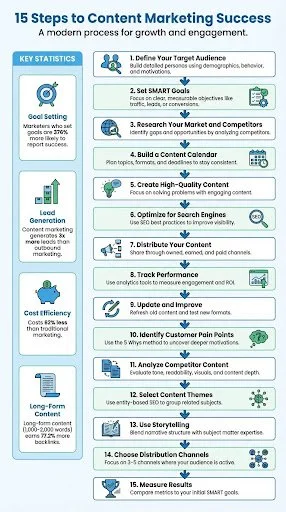
Step Content Marketing Success Checklist
Complete Content Marketing Guide to Kickstart Your Success
Step 1: Define Your Target Audience
Understanding your target audience is the bedrock of any successful content strategy. Without clarity about who you're speaking to, your content risks being generic and ineffective. To avoid this, focus on three main areas: demographics (age, job title, location, income), behavioral factors (buying habits, search patterns), and psychographics (motivations, values, and decision-making drivers).
As user behavior evolves, it's crucial to recognize new discovery trends. While traditional search engines are still relevant, platforms like ChatGPT, Reddit, and TikTok are becoming key sources for finding information. For instance, users might turn to Reddit for unfiltered reviews or TikTok for quick, visual tutorials. Knowing where your audience seeks answers will help you choose the right platforms and content formats to connect with them effectively.
"If you don't have a clear idea of who you're writing to, the end result will be bland, generic content that misses the mark for everyone." – Sherice Jacob, Copywriter and Content Professional, Originality.AI
The numbers back this up: customer-centric brands are 60% more profitable, and companies excelling in personalization see a 40% revenue boost. Additionally, 74% of marketing teams rely on customer personas to guide their strategies.
Use Data to Build Customer Personas
Start by digging into Google Analytics. Look for landing pages where users spend over two minutes - this indicates strong engagement. Use the "Demographics" and "Interests" tabs to uncover audience segments like "Technophiles" or "News Junkies." This first-party data provides a solid foundation for creating personas based on real behavior.
Your sales and support teams are another goldmine of information. They deal with customer objections and questions every day, offering insights into the challenges your audience faces. For B2B audiences, you can even estimate disposable income by comparing average salaries with typical expenses.
Social listening tools can also help you tune into your audience's authentic language. Platforms like Reddit or Facebook Groups often reveal raw, unfiltered feedback that surveys might miss. When conducting interviews, aim to include three groups: current customers, potential leads, and loyal advocates who actively promote your brand.
Don’t forget to create negative personas - profiles of people who aren’t a good fit for your product or service. This helps you avoid wasting time and resources on the wrong audience. And remember, personas should evolve. Update them at least once or twice a year to reflect shifts in the market and consumer behavior.
Once you’ve developed your personas, the next step is to identify their specific challenges.
Identify Customer Pain Points and Interests
To truly connect with your audience, dive deep into their frustrations, challenges, and goals. Use psychographics and techniques like the "5 Whys" method - start with a content idea and ask "why" five times to uncover the deeper motivations behind their needs.
Pinpoint the triggers that push your audience to seek solutions. These could be anything from an urgent deadline to a competitor’s actions or even budget approvals. By understanding these moments, you can craft timely, relevant content that resonates. Additionally, focus on proof points that build trust, such as expert credentials, original research, or detailed case studies.
The way people search for information is changing. In 2025, user refinement queries dropped by 20% because AI tools began providing complete answers upfront. This shift means your content needs to deliver clear, actionable solutions right away to satisfy both readers and AI-driven platforms. For instance, Diggity Marketing found that by prioritizing quality and relevance, they achieved a 527% increase in website traffic.
"Help your audience first, and the results will follow."
– Kim Kovelle, Content Manager, Zoe Marketing & Communications
Step 2: Set SMART Goals for Your Content Strategy
Once you understand your audience, the next step is to define clear, measurable goals for your content strategy. Without these, content marketing risks becoming an expensive exercise in publishing without purpose or measurable results. And here's why this matters: marketers who set goals are 376% more likely to report success, and 70% of them actually achieve those goals.
The SMART framework is an effective way to stay on track:
Specific: Focus on one clear metric, like website traffic, email subscribers, or trial signups, rather than vague goals like "increase brand awareness".
Measurable: Use analytics tools to track and quantify progress.
Achievable: Set goals that are realistic based on your budget, team size, and current capabilities.
Relevant: Ensure your content goals align with broader business objectives, such as increasing revenue or entering new markets.
Time-bound: Establish deadlines to create accountability and momentum.
"A strong content strategy guides content topics and formats aligned with business goals, so you're not just cranking out content for content's sake."
– Carl Broadbent, Digital Marketing Expert
To structure your goals, try this formula: "By {date}, the {team name} will reach {number} {metric} every {time frame}". For instance: "By December 31, 2026, the content team will reach 50,000 organic visitors every month."
When setting goals, align them with the different stages of your buyer's journey:
Top of the funnel: Focus on awareness metrics like page views or social media followers.
Middle of the funnel: Track engagement through email signups or the quality of leads generated.
Bottom of the funnel: Measure conversions, such as demo requests or sales.
Before locking in your goals, take a step back and assess your current content and team capacity. If resources are tight, outsourcing tasks like video production or technical SEO could help. For more ambitious goals, use a multiplier to challenge your team while staying realistic. Finally, prioritize your goals to ensure your immediate efforts are focused where they’ll have the most impact.
Step 3: Research Your Market and Competitors
Getting to know your market and competitors is a critical part of developing a strong content strategy. Interestingly, only 29% of marketers have a documented content strategy that works effectively, and skipping the research phase is often the reason why. When you dig into what your competitors are doing and listen to what your customers want, you can create content that solves real problems instead of blending into the noise.
Start by identifying two types of competitors: direct and indirect. Direct competitors sell the same products to the same audience, while indirect competitors address the same problem but with different solutions. For example, in the project management software space, direct competitors might be other software providers, while indirect competitors could include productivity consultants or downloadable Excel templates.
Analyze Competitor Content
Looking at your competitors’ content can help you spot ways to stand out. A simple trick is to use the Google search operator site:[competitor-url]/blog/ to browse their entire blog library and see how they structure their topics. But don’t stop at the surface - evaluate their tone, readability, visuals, and the depth of their content. These insights can reveal opportunities for differentiation.
Pay attention to the types of content they produce and where they distribute it. For example, if they focus heavily on blog posts but barely touch platforms like LinkedIn or TikTok, you might find a chance to outshine them there. Similarly, if their content is frequent but shallow, you could create more detailed, high-value pieces. Long-form content, especially articles over 7,000 words, generates nearly four times more traffic than shorter pieces. Plus, 83% of B2B marketers stand out by focusing on higher-quality content.
Another great tactic is to explore the "People Also Ask" section in Google search results. This can uncover questions your audience is curious about but that competitors haven’t fully addressed. You can also find valuable insights in the comments on their social media posts or YouTube videos, where customers often share objections or use specific language that resonates with your target audience.
While competitor insights are invaluable, pairing them with real customer feedback takes your strategy to the next level.
Collect and Use Customer Feedback
Competitor research is only part of the equation - your customers’ input is just as important. Your existing customers can guide you on what content to create next. Collaborate with your sales and customer success teams, as they often hear customer frustrations, questions, and goals directly. Ask them questions like, "What concerns or challenges do customers share before making a purchase?" or "What questions do they ask most often?"
Outside of internal feedback, platforms like Reddit and Quora are goldmines for honest industry conversations. Using search operators such as site:reddit.com [your keyword] can help you find threads where people discuss frustrations or ask questions that aren’t well answered elsewhere. Interestingly, 33% of marketers now use AI tools to enhance their research efforts.
You can also send short email surveys with questions like, "What was your biggest challenge before finding us?" or "Which search terms did you use?" Review platforms like G2 or Capterra are another great source for spotting recurring complaints about competitors’ products. These insights can fuel content ideas that address real pain points in your audience’s own words. By tackling these issues head-on, you build trust and create content that truly connects with your audience.
Step 4: Build a Content Calendar
Once you've done your research and gathered insights, the next step is to create a content calendar. This tool will help you map out what content you'll produce, when it will be published, and who will be responsible for each task. A well-organized calendar ensures your content aligns with your strategy and keeps everything running smoothly. Without one, you risk missed deadlines and inconsistent publishing. Here's an interesting stat: marketers who plan their efforts ahead of time are 331% more successful than those who don't.
Your content calendar should include key details like your target audience, SMART goals, content formats, timelines, responsibilities, and performance metrics. To make it even more effective, consider adding sections such as:
Editorial: For scheduled content.
Platform: To track where content will be hosted.
Promotional: For distribution plans.
Future Ideas: A space for brainstorming and capturing new concepts.
It's also important to track the entire process - from research and outlining to drafting, expert reviews, visual asset creation, and final approval. Keeping tabs on every stage helps you stay organized and ensures nothing falls through the cracks.
The best tool for managing your calendar depends on your team's size and needs. For solo creators or small teams, Google Sheets or Google Calendar are free and flexible options. Mid-sized teams often prefer tools like Trello or Asana, which offer task management and Kanban boards. Larger teams or agencies might need more advanced platforms like CoSchedule, which offers automation and capacity planning. For example, Singularity Hub uses Airtable to manage content across multiple channels, organizing tasks by author and providing a "Publish" calendar view for upcoming content. Similarly, the QuickBooks Resource Center uses Airtable to strategize and manage production, linking drafts and published pieces in a main grid view.
Select Content Themes
Once your calendar is set up, it's time to define content themes to guide your messaging. These themes ensure your content stays focused and resonates with your audience. Instead of posting random topics, use entity-based SEO to group related subjects and build authority through topic clusters. For instance, a SaaS company might dedicate a month to product updates and tutorials, while an ecommerce brand could focus on seasonal gift guides and buying tips.
Strike a balance between evergreen content - which generates long-term organic traffic - and timely content, which supports product launches or seasonal trends. If you're launching a new platform, prioritize evergreen content (over 50%) to establish a strong foundation, then mix in event-driven pieces. Review your existing content to identify gaps or opportunities to repurpose older materials.
Create an Editorial Schedule
An editorial schedule helps you assign deadlines, topics, and content formats, ensuring a consistent publishing routine. Start with a workback schedule that sets milestones for research, creation, and review, all leading up to the final deadline. It's also wise to build in a 20% buffer to handle unexpected delays or breaking news.
Consistency is critical. For blogs, publishing at least two posts per week is linked to better results, according to the Orbit Media 2024 Blogger Survey. On social media, aim for 3–5 Instagram posts per week, 1–2 Facebook posts per day, and 1–2 LinkedIn posts per day. It's better to stick to a realistic, steady schedule than to risk burnout by overcommitting. Using color-coding or tags to differentiate content types, statuses (e.g., "In Progress" or "Review"), or distribution channels can make your schedule even clearer. Don't forget to include a "Future Ideas" tab for brainstorming and organizing potential topics.
Step 5: Create High-Quality Content
Now that your content calendar is set, it’s time to focus on crafting content that truly delivers value. Great content solves problems and achieves specific goals. Did you know that content marketing generates three times more leads than outbound marketing while costing 62% less? That’s a huge opportunity to engage your audience effectively.
To succeed, start with the "Hook & Hold" method. Your content needs to grab attention right away with a strong headline or by addressing a clear pain point (the hook). Then, keep readers engaged by incorporating authority, research, visuals, examples, and statistics (the hold). For instance, long-form content (1,000–2,000 words) performs exceptionally well, earning 77.2% more backlinks and generating 56.1% more social shares than shorter posts. But don’t rely on length alone - your content must reflect E-E-A-T: Experience, Expertise, Authoritativeness, and Trustworthiness.
Make your content easy to read and navigate. Use headings (H1, H2, H3), short paragraphs (3-4 sentences max), bullet points, and bold text to cater to today’s shorter attention spans. Answer the reader’s main question early to show immediate relevance. Before writing, research your target keyword to see what format Google favors - whether it’s product pages, guides, or videos - and align your content accordingly.
Use Storytelling and Expert Knowledge
Once you’ve outlined your content, bring it to life with storytelling and expert insights. The best content blends narrative structure with subject matter expertise. Classic storytelling techniques, like "The Quest" (overcoming challenges) or "Overcoming the Monster" (defeating a tough obstacle), can make your message stick. But remember, storytelling is only effective when backed by real knowledge.
"If you want an article about how to unclog a toilet, don't hire a freelance writer. Hire a plumber."
-Brian Dean, Founder, Backlinko
Tap into internal expertise by interviewing your team or having specialists contribute directly. Take Steve Kamb, founder of Nerd Fitness, as an example. He created one of the world’s most popular fitness blogs by blending his personal fitness journey with expert-backed research on workouts and diets. This approach gave his content credibility and authority. Similarly, Semrush achieved success in 2024 by publishing detailed "Success Stories" that showcased specific ranking improvements and ended with clear calls-to-action for free trials - capturing audiences ready to act.
"Training your content team to be subject matter experts may be more effective than teaching SMEs to excel at writing."
-Robert Rose, Chief Strategy Advisor, Content Marketing Institute
Consider forming an editorial board to identify the topics where your brand can provide the most value. Give your writers and experts detailed content briefs that explain the purpose, target audience, and key messages to ensure consistency. For complex topics, prioritize input from specialists or practitioners rather than relying on generalists.
Maintain Consistent Quality Across Formats
Whether you’re creating blog posts, videos, or social media content, consistency is key. Start by developing a style guide that outlines formatting, tone, and voice to maintain uniformity across contributors. Establish a review process with checklists that cover SEO, grammar, and calls-to-action. For technical or AI-generated content, include peer reviews and human expert oversight.
Repurpose your best-performing content into different formats. For example, turn long-form articles into social media posts, email newsletters, or short-form videos. Short-form videos, in particular, are 2.5 times more engaging than long-form ones, and 77% of experts consider them a key focus. However, keep in mind that over 70% of B2B buyers prefer content that dives deep into specific topics. Strike a balance between bite-sized content and thorough explorations.
After writing, wait 24–48 hours before revising. This break helps you spot repetitive or unnecessary wording more effectively. Always verify your data by tracing statistics back to their original sources instead of relying on third-party summaries. Regularly audit your content library to update outdated information and keep your material accurate and reliable.
Step 6: Optimize Content for Search Engines
SEO ensures your content gets discovered, helping it appear in search results. The top spot in search results boasts a 27.6% click-through rate, yet a surprising 68% of marketing teams still rely on outdated optimization tactics that fail to align with modern algorithms.
Google now emphasizes content that demonstrates Experience, Expertise, Authoritativeness, and Trustworthiness (E-E-A-T). Meanwhile, 58.5% of US Google searches now end without a click, as AI-generated answers and featured snippets provide users with instant information. To stay competitive, structure your content for both traditional search results and emerging AI tools like Google's AI Overviews.
Conduct Keyword Research
Building on your earlier research, the goal here is to make your content both user-friendly and optimized for search engines.
Start by identifying 3–5 key topics that resonate with your audience's language. Then, expand these into long-tail keyword variations using tools like Google Autocomplete. Simply type your topic into Google’s search bar, and you'll see suggested phrases based on real search behavior.
Classify your keywords into one of four intents:
Informational: For users looking to learn something.
Commercial: For those comparing options.
Navigational: For users seeking a specific website.
Transactional: For those ready to make a purchase.
To confirm the intent of a keyword, search it in incognito mode and review the top five results. For example, if you see comparison articles or reviews, the intent is likely commercial. Align your content format with what’s already ranking - if listicles dominate the results, create one; if guides are prevalent, write a guide.
"Keyword research isn't dead. Bad keyword research is dead."
-NextGrowth.ai
Focus on long-tail keywords - specific phrases with lower search volume but higher intent. While 94.74% of all keywords get 10 or fewer monthly searches, targeting these collectively can drive meaningful traffic. Use free tools like Google Search Console, Google Trends, and AnswerThePublic (which offers three free searches daily) to uncover these opportunities.
Once you’ve identified your target keywords, the next step is to weave them effectively into your content.
Optimize On-Page Elements
With your keywords in hand, strategically incorporate them into key on-page elements. Place your primary keyword early in your title tag and within the first 100–150 words of your content. Keep title tags under 60 characters to avoid truncation and use modifiers like "Best", "Checklist", or the current year to attract long-tail traffic.
For meta descriptions, focus on the outcomes your content delivers rather than just summarizing it. Limit these descriptions to 155–160 characters to ensure they display fully in search results. Use one H1 tag for your main title, and organize your content with H2 and H3 tags to establish a clear hierarchy. When adding images, use descriptive filenames (e.g., "content-marketing-checklist.png") and include keyword-rich alt text to help search engines understand the image content.
"The most basic signal that information is relevant is when content contains the same keywords as your search query."
Answer the main query directly within the first 100–150 words of your content to qualify for featured snippets, which achieve a 42.9% click-through rate - far higher than the 19% for the top organic result. Break your content into clear, digestible sections with summary introductions, a technique called "semantic chunking." This approach helps AI tools like ChatGPT and Google's AI Overviews cite your content effectively.
Lastly, include 2–5 internal links to other relevant pages on your site and link to credible external sources. This not only improves navigation but also builds trust with both users and search engines.
Step 7: Distribute Your Content
Once your content is optimized for search engines, the next step is to ensure it reaches the right people. Even the best content won't make an impact if it just sits on your website. The trick is knowing where your audience spends their time and tailoring your distribution strategy to meet them there.
Here’s the reality: creating great content is just 20% of the job. The other 80%? Getting it in front of the right audience. A well-planned distribution approach is critical to making sure your hard work pays off.
Choose Distribution Channels
Start by focusing on three to five channels where your audience is most active. Tools like Google Analytics can help you figure out which platforms are already driving the most traffic and leads to your site. Once you know where your audience is, concentrate your efforts there.
To structure your strategy, use the OEP Framework - Owned, Earned, and Paid channels. Here’s a quick breakdown:
Owned channels: These include your email list, blog, or SMS campaigns. You control these entirely, making them reliable long-term options.
Earned channels: Think SEO, social shares, and backlinks. These build trust and expand your reach organically.
Paid channels: Social ads, PPC campaigns, and influencer partnerships fall here. They provide immediate visibility and help you scale quickly.
A balanced approach works best. Owned channels give you a strong foundation, earned channels build credibility, and paid channels help you reach more people when needed. Check out the table below for a clearer picture:
| Channel Type | Examples | Best For | Control Level |
|---|---|---|---|
| Owned | Email, Blog, SMS | Nurturing existing audiences | High |
| Earned | SEO, Social Shares | Building trust and credibility | Low |
| Paid | Social Ads, PPC | Immediate reach and scaling | Medium |
| Persona Type | Key Characteristics | Content Strategy Approach |
|---|---|---|
| Type A | Results-oriented, competitive, high achievers | Use messaging that triggers FOMO and highlights efficiency |
| Type B | Creative, flexible, big-picture thinkers | Focus on out-of-the-box ideas and fresh perspectives |
| Type C | Analytical, detail-oriented, cautious | Stick to facts, data, and logical reasoning |
| Type D | Risk-averse, security-focused, socially reserved | Emphasize trust, stability, and reassurance |
Also, remember that content tailored to each platform performs better. For example, instead of sharing a blog link on LinkedIn, turn it into a carousel post - these generate 3x more impressions than posts with external links. On Twitter, break down key points into a thread. For YouTube, create videos with chapters and timestamps, which can boost view duration by 28%. Adapting your content to each platform’s format is worth the effort.
Timing is another critical factor. Most content earns 70% of its lifetime engagement within the first 72 hours of publication. For B2B audiences, engagement typically peaks Tuesday through Thursday, between 9:00 AM and 11:00 AM in their local time zone. Plan your posting schedule to take advantage of these windows.
Once your channels are set, you can dive deeper into social media and paid strategies to amplify your reach.
Use Social Media and Paid Advertising
Social media plays a huge role in distribution, but it takes more than just posting a link. With algorithm changes, fewer than 6% of Facebook Page followers see organic posts. To get around this, you’ll need a smarter approach.
One effective tactic is employee advocacy. When your team members share content on their personal LinkedIn profiles, those posts can get 10x to 30x more impressions than posts from your company’s page. Encourage your team to share your content and tag any experts or brands mentioned to increase the chances of it being shared further.
To track your efforts, use UTM parameters for every link you share. These codes let you see which platforms and campaigns bring in the most qualified leads and revenue.
When it comes to paid ads, focus your budget on content that’s already performing well organically. If a post is generating strong engagement, saves, or click-through rates, amplifying it with targeted ad spend can expand its reach even further. For businesses with smaller audiences, investing in professional social media management or paid advertising can help build visibility while your organic presence grows.
"Content is king, but distribution is queen. And she wears the pants."
-Jonathan Perelman,BuzzFeed
Finally, if you’re syndicating your content to platforms like Medium or industry blogs, wait 48–72 hours after publishing on your site. This gives search engines time to index your original piece first. Always include a rel="canonical" tag that links back to your original URL to protect your SEO and avoid duplicate content issues.
Step 8: Track Performance and Measure Results
Once you've distributed your well-crafted, optimized content (Step 7), the next critical step is tracking its performance. Without measuring results, you're essentially flying blind - guessing what works and what doesn't. Monitoring performance helps you identify which content resonates most and which platforms deliver the best outcomes.
Here’s a reality check: 61% of content marketers can’t confirm if their content generates revenue. Don’t be part of that statistic. The secret lies in tracking the right metrics with the right tools and comparing them to the SMART goals you established earlier.
Use Analytics Tools
Start with Google Analytics 4 (GA4). To analyze your content’s performance, go to Reports > Engagement > Pages and screens. This will show you which topics are getting the most views and how long users are engaging with your pages. GA4 now uses "Average Engagement Time" instead of the outdated bounce rate metric, focusing on how actively users interact with your content. For long-form content (2,000+ words), aim for an engagement time of 2–4 minutes.
Want deeper insights? Set up custom events in GA4 to track scroll depth (e.g., 25%, 50%, 75%) and key actions like newsletter signups or demo requests.
Google Search Console (GSC) is another must-have tool for monitoring organic search performance. Keep an eye on keyword rankings, impressions, and click-through rates (CTR). If certain pages have high impressions but low clicks, tweak your titles or meta descriptions to boost performance. For reference, pages ranking in Position 1 typically see a 25% to 30% CTR, while Position 3 pages average 10% to 15% CTR.
For competitive insights, tools like Semrush orAhrefs can track backlinks, analyze competitor strategies, and even measure "AI visibility" - how often your brand shows up in AI-powered responses like ChatGPT or Google’s AI Overviews. This metric is becoming increasingly relevant as AI-driven search grows. For example, Wikipedia saw an 8% drop in traffic in 2025, largely due to AI search engines pulling answers directly.
If you’re serious about connecting content to revenue, integrate a CRM platform like HubSpot or Salesforce. These tools help track your "content-sourced pipeline", showing which pieces of content generate actual leads. Michael Alexis, CEO of teambuilding.com, shared this insight:
"We switched from tracking all Acquisition and Behavior data to only looking at the data that results in Goal Conversions. The result... has been that we are now crystal clear on what drives actual leads and revenue for our business."
Don’t forget to use UTM parameters on every link. This will let you pinpoint which distribution channels - email, LinkedIn, Twitter - are driving traffic and conversions.
Compare Results to Goals
To evaluate your content’s effectiveness, compare the metrics you’ve gathered to your initial objectives. For example:
If your goal is brand awareness, track metrics like Share of Voice and branded search volume.
For lead generation, focus on conversion rates and marketing-qualified leads (MQLs).
Keep in mind that blog-to-lead conversion rates vary by industry. B2B SaaS companies often see rates between 1% and 3%, while local service businesses might hit 3% to 7% due to stronger search intent. Bottom-of-funnel content typically converts at 5% to 8%, whereas top-of-funnel content averages only 0.5% to 1.5%. If your bottom-of-funnel content isn’t converting at least twice as well as your educational content, it may indicate a misalignment between user intent and your call-to-action.
GA4's "Conversion Paths" feature is particularly useful for tracking assisted conversions - content that contributes to a sale even if it wasn’t the final touchpoint.
To calculate ROI, use this formula: ROI = (Net Profit / Cost of Investment) x 100%. Don’t forget to include costs like internal time and tool subscriptions in your calculations. A 3:1 ROI is often considered a strong benchmark - every $1 spent should generate $3 in revenue.
Here’s an example of what data-driven content optimization can achieve: In November 2025, marketing agency Fluentica helped their client ABA Matrix grow to over 34,000 monthly organic visits. Co-Founder Amy Perez discovered that "how-to" guides and time management resources outperformed compliance-heavy articles in rankings, backlinks, and conversions. This insight allowed ABA Matrix to expand beyond Florida and compete on a national level.
"ABA Matrix scaled to 34,000+ monthly organic visits, improved its competitive positioning against national players, and began generating leads beyond Florida, fueling its visibility and expansion goals." - Amy Perez, Co-Founder, Fluentica
Finally, remember that success takes time. The average page takes 3 to 6 months to break into the top 10 search results. As The SEO Engine Editorial Team puts it:
"The #1 reason content marketing programs get killed isn't poor performance - it's measuring Month 3 results with Month 12 expectations."
Make it a habit to spend 30 minutes every Monday reviewing organic traffic and click trends in GSC. Regularly analyzing your data ensures your content strategy stays flexible and focused on delivering measurable results.
Step 9: Improve Your Strategy Over Time
Once you've set up tracking and distribution, the next step is to keep refining your content strategy. Content marketing isn’t something you can just set up and forget. It’s an ongoing process that requires consistent adjustments based on performance data. Interestingly, updating old content can deliver results that are 2.3 times better than creating new content within the first six months. Regular updates ensure your strategy stays aligned with changing market trends and audience preferences.
Think of your content like a lifecycle: Early Traction, Growth, Peak, and Decline. When traffic and engagement start to dip - that's the Decline stage - it’s your cue to take action. As Brody Hall from Loganix wisely puts it:
"Unlike diamonds, content isn't forever. Left untouched, it'll eventually fall out of favor."
The challenge is figuring out which content needs attention and how to test new approaches. Let’s break this down.
Update Old Content
Start by identifying pages that need work. Tools like GA4 and Google Search Console are perfect for spotting pages that were once top performers but are now slipping or have outdated information.
Once you’ve identified underperforming pages, take one of these actions:
Keep pages that still meet your goals and provide accurate, relevant information.
Update pages with outdated data or declining rankings.
Consolidate similar pages competing for the same keyword into one stronger "pillar" page.
Delete pages with zero traffic, no backlinks, and little relevance to your current goals.
Here’s a practical tip: refresh your top-performing pages every three months by adding new data, expert opinions, or current examples. For evergreen content, updates every 12–18 months are usually enough. But if you’re in a fast-evolving industry like tech or fashion, aim for updates every 3–6 months.
Focus on content ranking between positions 11–30. These "low-hanging fruit" pages often need just minor tweaks to break into the first page of search results. Compare your content to the top-ranking pages to check if search intent has shifted. When you refresh content, update the "last updated" date - this signals freshness to both users and search engines. After making changes, give it about three to four months for search engines to process and stabilize rankings.
Finally, don’t stop at updates. Experiment with new formats and ideas to keep things fresh.
Test New Ideas and Formats
Experimentation is how you discover what truly connects with your audience. Start by repurposing long-form content into other formats - turn blog posts into videos, infographics, or social media snippets. Visual content tends to perform better, generating 94% more views than text-only content. Adding custom graphics or data visualizations can also make your content more engaging.
Try using an "answer-first" structure where you present the main answer within the first 2–3 sentences. This approach increases your chances of appearing in rich snippets and being cited by AI tools. As Katteb Blog explains:
"If your answer isn't clear within 10 seconds, it's probably too vague for AI to use."
Go beyond traditional SEO methods. Experiment with voice search optimization by incorporating conversational keywords and natural language patterns. Also, focus on how well your content addresses related concepts and entities, which helps AI systems understand its context better.
Track the results of your experiments using analytics tools, paying attention to metrics like engagement time and conversion rates - not just traffic. Remember, strategic content creation generates three times more leads than outbound marketing while costing 62% less. Even small improvements can lead to big wins. As digital marketing strategist Rajesh R Nair puts it:
"Consistency beats perfection."
The most successful strategies come from businesses that continuously test, learn, and refine. Keep experimenting and evolving to stay ahead.
Conclusion
Content marketing doesn’t have to feel overwhelming. By using this 15-step checklist, you can turn a chaotic publishing process into a repeatable system that drives measurable results. This method brings structure to your efforts, minimizes costly mistakes, and ensures every piece of content reflects your brand's voice and objectives.
Here’s what the numbers tell us: dedicate about 20% of your content marketing time to research and planning. And when it comes to output, four high-quality posts each month often outperform twenty average ones. As Atul Gawande, author of The Checklist Manifesto, puts it:
"Good checklists … are precise. They are efficient, to the point, and easy to use even in the most difficult situations. They do not try to spell out everything... Instead, they provide reminders of only the most critical and important steps--the ones that even the highly skilled professional using them could miss."
By relying on proven strategies and focusing on measurable outcomes, you can reshape your content marketing approach. Start implementing these steps now. Build consistency, set SMART goals, and experiment with new formats when needed. Success lies in creating habits around a structured process rather than waiting for inspiration to strike.
If managing all 15 steps feels like too much, professional help can make a big difference. Burt's Media specializes in simplifying content marketing. From audience research and content creation to distribution and performance tracking, we handle it all - so you can focus on growing your business. Let us help you turn this checklist into a growth engine for your brand. Reach out today to see how we can support your content strategy.
FAQs
-
Research your audience
Understand who you're speaking to. Identify their challenges, interests, and the platforms they frequent. This ensures your content resonates with the right people.Set clear goals
Outline specific objectives for your content. Whether it’s driving traffic, generating leads, or boosting engagement, tie these goals directly to your business priorities.Plan your content
Map out your ideas. Choose topics that align with your goals, and organize them in a content calendar to maintain consistency and keep your strategy on track.
These three steps lay the groundwork for a successful content marketing approach.
-
To get started, focus on creating a well-defined content strategy. This means outlining your goals and understanding what your audience prefers. Ask yourself: Where does your audience spend their time? Are they scrolling through blogs, engaging on social media, or watching videos?
Experiment with different platforms to see what works best. Once you’ve tested the waters, use data to measure how your content is performing. Identify the role of each channel - whether it’s meant to build awareness or drive conversions - and make sure everything ties back to your business goals. This way, your efforts won’t just make noise; they’ll deliver results.
Next, track micro-conversions - actions users take before completing a full conversion. These might include signing up for a newsletter, downloading a guide, or engaging with a CTA. They’re great indicators of how your content delivers value before leading to a conversion.
For a more complete picture, use multi-touch attribution models. These help you map out how your content contributes across the entire sales funnel, from initial awareness to final purchase.
Finally, make it a habit to audit content performance regularly. Look at traffic, engagement, conversion rates, and revenue data to ensure your KPIs align with your business goals and reflect real-world outcomes.
-
Content marketing can often show measurable results in as little as 90 days when following a structured, sprint-based approach. By maintaining a well-executed strategy and consistently monitoring performance for adjustments, noticeable growth is usually achieved by the end of this timeframe.
