
How to Create a Content Strategy That Drives Results

A clear content strategy is the difference between random posts and meaningful results. Companies with a documented plan are three times more likely to succeed. Here’s how to make your strategy work:
Set SMART Goals: Define specific, measurable, and time-bound objectives, like increasing organic traffic by 30% in six months.
Know Your Audience: Research deeply to create detailed buyer personas based on demographics, behaviors, and challenges.
Choose the Right Formats: Match content types (blogs, videos, etc.) to your audience's preferences and the buyer's journey.
Stay Consistent: Use a content calendar to plan, post regularly, and avoid last-minute chaos.
Track Metrics That Matter: Focus on KPIs like conversions, engagement time, and SEO performance - not vanity metrics like likes.
Refine Based on Data: Update underperforming content and double down on what works.
Key Takeaway: A well-documented strategy ensures every piece of content aligns with your goals, resonates with your audience, and delivers measurable results.
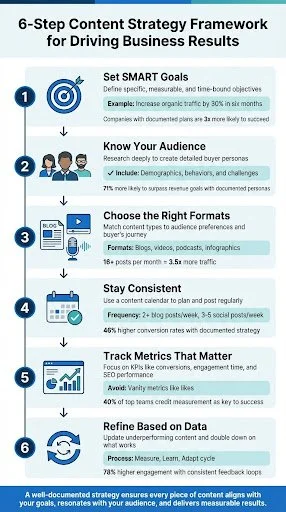
6-Step Content Strategy Framework for Driving Business Results
How to Create a Content Marketing Strategy that Works [Beginners Guide]
Set Clear, Measurable Goals
Before diving into content creation, you need a clear objective. Without defined goals, your strategy risks wasting time and effort. Purposeful content transforms random pieces into strategic assets that serve specific business needs - whether that's generating leads, retaining customers, or building brand awareness. This clarity ensures your efforts lead to measurable results.
The SMART framework is a great tool to guide this process. Goals should be:
Specific: Clearly define your target.
Measurable: Attach metrics to track progress.
Achievable: Set realistic expectations based on available resources.
Relevant: Align with broader business priorities.
Time-bound: Set a clear deadline.
For instance, instead of saying, "get more traffic", a SMART goal would be: "Increase organic blog traffic by 30% within six months by publishing detailed, in-depth guides."
"Content marketing isn't just about producing articles or videos; it's about crafting a purposeful strategy that directly supports your business goals." – Mailchimp
Align Content Goals with Business Objectives
Your content goals should directly support your business objectives. For example, if your priority is expanding the sales pipeline, focus on creating content that captures qualified leads. If your goal is customer retention, aim to reduce churn by 15% with onboarding tutorials or best practices guides.
MarketingProfs offers a great example of this approach. By using a documented content strategy driven by audience insights, they boosted audience engagement by 40%. To replicate this, start with a content audit to evaluate what’s working and identify gaps in addressing your business goals. Then, bring together teams from sales, customer service, and product development to align on shared priorities.
Structure your content to match the buyer’s journey:
Awareness stage: Educational blog posts or videos to build visibility.
Consideration stage: Comparison guides or gated resources to capture leads.
Decision stage: Case studies or product demos to drive conversions.
This targeted approach ensures every piece of content serves a purpose - moving prospects closer to making a purchase. For each stage, set measurable targets and track progress with precise KPIs.
Establish Key Performance Indicators (KPIs)
Once your goals are in place, you need metrics to measure success. KPIs can be:
Quantitative: Data like traffic, conversions, or revenue.
Qualitative: Insights like customer sentiment or brand perception.
Choose up to five key metrics that align with your SMART goals. Avoid vanity metrics - like social media likes - that don’t directly impact your bottom line.
| Business Goal | Content Strategy Focus | Primary KPI | Example Metric |
|---|---|---|---|
| Increase Brand Awareness | Educational, top-of-funnel content | Website Traffic & Reach | +20% organic traffic quarter-over-quarter |
| Generate More Leads | Gated resources and webinars | Lead Conversion Rate | 5% conversion on ebook landing page |
| Improve Customer Retention | Tutorials and best practice guides | Customer Churn Rate | -15% churn for engaged users |
| Drive Direct Sales | Product demos and comparison pages | Sales Conversion Rate | 3% of readers starting a paid trial |
To track these metrics, create custom dashboards in Google Analytics 4 for specific events like PDF downloads or pricing page visits. Use UTM parameters to tag content links and monitor their influence on leads and sales through your CRM. For engagement, aim for a "pages per session" benchmark of 2 or higher, signaling that users are genuinely interacting with your content.
Identify and Understand Your Target Audience
With clear, measurable goals in place, the next step is figuring out exactly who your message is for. You can't create content that truly connects if you don't know your audience. Researching your audience is the backbone of any effective content strategy - it shifts the focus from what you want to say to what your audience needs to hear. Without this step, you're essentially throwing resources away.
Here's the issue: 41% of marketers admit they don't conduct enough audience research. This lack of insight often leads to content that misses the mark. The solution? Use a mix of methods - direct conversations, digital analytics, and social listening - to build a well-rounded understanding of your audience and what influences their decisions.
Develop Detailed Buyer Personas
A buyer persona is a detailed profile of a target audience segment that highlights their behaviors, motivations, and pain points. Businesses that document these personas are 71% more likely to surpass their revenue and lead goals.
Start by gathering quantitative data from tools like Google Analytics 4, your CRM, and social media insights to spot demographic and behavioral trends. Then, dive deeper by conducting one-on-one interviews with 3–7 individuals per persona. Include a mix of current customers, potential customers, and even team members to uncover the "why" behind the data.
"Listen closely to their stories until their dreams and fears start to feel like your own." – Joe Lazer, Author
Each persona should cover key details like:
Demographics: Age, location, income, job title
Psychographics: Values, interests, lifestyle
Behavioral Patterns: Preferred content channels, buying triggers
Goals and Challenges: What they want to achieve and the obstacles they face
Decision Criteria: What influences their choices
Give each persona a relatable name and photo (e.g., "Marketing Mary") and create a brief "day-in-the-life" profile using real customer quotes to make them feel authentic.
Don't just talk to happy customers - reach out to dissatisfied ones and even those who chose competitors. This can help you identify friction points that need addressing. Additionally, consider creating negative personas to define who you don’t want as customers. This can save you from wasting ad spend and improve the quality of your leads.
Keep your personas updated every 6–12 months to reflect market changes. Test them against your campaign results to ensure they're still accurate. Brands that prioritize understanding their customers are 60% more profitable than those that don’t.
Use Audience Insights for Better Targeting
Once your buyer personas are set, the next step is to use ongoing data to fine-tune your targeting. Google Analytics 4, used by over 37.9 million websites worldwide, offers insights into demographics, interests, and on-site behavior. It shows which pages users visit, how long they stay, and where they drop off. Similarly, social media platforms like Facebook and Instagram provide data on which posts resonate most with your audience.
To dig even deeper, try social listening tools like Brandwatch or Hootsuite. These can track conversations on platforms like Reddit, Quora, and Twitter, giving you a clearer picture of your audience's concerns and interests. Customer service chat logs and sales call recordings are also goldmines for identifying recurring frustrations and understanding the language your audience uses to describe their challenges.
Tools like SparkToro can pinpoint where your audience spends their time online - whether that's specific YouTube channels, podcasts, or websites. This allows you to meet them on the platforms they already use.
Another strategy is progressive profiling, where you collect data gradually through automated lead forms. This avoids overwhelming users with long forms upfront. And don't underestimate the power of zero-party data - information willingly shared through quizzes, surveys, or preference centers. It's both ethical and effective, especially as privacy regulations continue to evolve. This ongoing feedback loop ensures your content keeps pace with your audience's needs.
| Persona Type | Key Characteristics | Content Strategy Approach |
|---|---|---|
| Type A | Results-oriented, competitive, high achievers | Use messaging that triggers FOMO and highlights efficiency |
| Type B | Creative, flexible, big-picture thinkers | Focus on out-of-the-box ideas and fresh perspectives |
| Type C | Analytical, detail-oriented, cautious | Stick to facts, data, and logical reasoning |
| Type D | Risk-averse, security-focused, socially reserved | Emphasize trust, stability, and reassurance |
Think of audience research as a continuous process. Brands that use consistent feedback loops report 78% higher engagement levels. The better you know your audience, the more effective your content will be.
Select Content Formats That Resonate
Once you’ve nailed down your audience, the next step is figuring out how to connect with them effectively. Not all content formats work for every audience or platform. The trick is to align your content with where your audience spends their time and how they prefer to consume information.
Start by reviewing what’s already working. A content audit can reveal which formats - like blogs, videos, or infographics - are driving the most traffic, engagement, or conversions. Take a peek at your competitors too. What’s generating buzz for them? This can help you spot ways to stand out or replicate successful trends.
Different formats serve different purposes in the buyer’s journey. For awareness, short videos and articles work well. During the consideration phase, webinars, case studies, and podcasts can be more effective. When prospects are ready to decide, tools like interactive quizzes or product demos can help seal the deal. Tools such as Semrush One2Target let you analyze whether your audience prefers YouTube videos over LinkedIn posts.
"You don't need to be everywhere … Start where you can be consistent (like text + image on LinkedIn). Depth beats distribution." – AJ Eckstein, Founder, Creator Match
Keep in mind that reach and engagement are not the same thing. For example, Instagram Reels get 39% more reach than carousels, but carousels drive 12% more engagement. On LinkedIn, document carousels generate 278% more engagement than videos. Facebook photos outperform text posts by 35% in engagement. And on X (formerly Twitter), text-only posts see 30% more engagement than videos. Choose formats based on whether your goal is to attract new followers or deepen relationships with your current audience.
Use High-Performing Formats
Some content formats simply perform better than others. Video is a standout for reach and discoverability across most platforms, making it a go-to choice for attracting new followers. Podcasts, on the other hand, are great for building loyalty, with over 30% of the U.S. population listening to at least one podcast each month. Blog posts also remain a powerhouse, with businesses publishing 16+ posts per month seeing 3.5 times more traffic than those publishing fewer.
The key is variety. People consume content differently depending on their mood or schedule. They might skim articles during a busy day, watch videos when they can focus, and listen to podcasts while multitasking. Offering a mix of formats ensures you’re meeting your audience wherever they are.
Take Lagavulin whisky as an example. They created a 45-minute video featuring Nick Offerman sitting by a fire. Despite being 15 times longer than the ideal YouTube video length, it racked up over 2 million views and tons of media attention.
A smart move is to repurpose one high-quality asset into multiple formats. For instance, a single webinar or in-depth guide can be transformed into an email series, a handful of social posts, an infographic, a podcast episode, and more. This approach amplifies your reach without adding tons of extra work.
| Content Format | Primary Strength | Best For |
|---|---|---|
| Blog Posts | SEO & Authority | Driving top-of-funnel traffic and aiding decision-making |
| Video | High Engagement | Branding, tutorials, and social sharing |
| Podcasts | Loyalty & Captive Audience | Building relationships during multitasking |
| Infographics | Shareability | Simplifying complex data and earning backlinks |
Consistency is just as important as format. Regular posting can boost likes, comments, and shares by up to 5 times. Companies with a documented content strategy see 46% higher conversion rates than those without one.
Adapt Content for Specific Platforms
Once you’ve chosen your formats, it’s crucial to tailor them to the strengths of each platform. What works on LinkedIn might flop on TikTok. Optimizing content for each platform is key to maximizing its impact.
"Video, Video, Video, Video... Keep an eye on video." – Callie Schweitzer, Head of Scaled Programs, LinkedIn
On Instagram, Reels are great for attracting new followers, while carousels are better for engaging your existing audience. TikTok thrives on videos, which get 18% more views than text posts, but you’ll need to hook viewers within the first 3 seconds. LinkedIn favors document carousels for engagement, while video is best for reach. On Facebook, photos outperform text and video in engagement. And on X (formerly Twitter), text-only posts drive 30% more engagement than videos.
| Platform | Best Format for Reach/Views | Best Format for Engagement |
|---|---|---|
| Reels (39% more reach than carousels) | Carousels (12% more engagement than reels) | |
| Video | Document Carousels (278% more engagement than video) | |
| TikTok | Video (18% more views than text) | Video |
| Video/Reels | Photos (35% more engagement than text) | |
| X (Twitter) | Video | Text Posts (30% more engagement than video) |
Always preview your content on mobile before posting, as most people consume content on smaller screens. Use tools like UTM parameters to track which formats and platforms drive the most conversions. Regularly check your analytics to spot trends, like whether “how-to” videos outperform blog posts, and refine your approach.
Modern search engines like Google AI Overviews now pull from multiple content types - text, visuals, and video. Creating diverse content boosts your chances of appearing multiple times in AI-generated answers. This makes offering a variety of formats essential for maintaining visibility.
Create a Content Calendar for Consistency
Once you've chosen your formats and defined your audience, the next step is creating a content calendar to keep everything organized. Think of it as your central hub for planning what content goes live, when, and who’s responsible for making it happen. Instead of rushing to meet deadlines, you’ll have a clear plan that keeps you ahead of the game.
Here’s a revealing stat: only 26% of B2B marketers feel their organization has the right tools to manage content effectively. On top of that, 33% admit their content strategy falters due to unclear goals or missing data. A well-thought-out content calendar can help fix these issues by directly tying each piece of content to a specific business objective.
Consistency is the secret sauce. Research shows that publishing at least two blog posts per week delivers strong results for most bloggers. For social media, Hootsuite suggests posting 3–5 times a week on Instagram, 1–2 times daily on LinkedIn, and 3–5 times weekly on TikTok. A calendar ensures you can keep up this pace without overwhelming your team.
"What separates high-performing content teams from others? More often than not, it's the planning." – Maddy Osman, Founder, The Blogsmith
Before jumping in, conduct a content audit to find high-performing evergreen pieces that can be updated or repurposed. Then, decide on a publishing frequency that fits your team’s capacity - quality always beats quantity.
Plan Content Topics and Publishing Schedules
Every post should align with your strategic goals. Organize your content into topic clusters to build expertise and boost SEO. For instance, a fitness brand might group topics like "strength training", "nutrition basics", and "recovery techniques."
Use a workback schedule to stay on track. Start with the final publication date and work backward, setting deadlines for each stage - research, writing, reviews, design, and stakeholder approvals. A typical timeline might look like this: 2–3 days for research, 5–7 days for creation, and 3–4 days for reviews, with a 20% buffer for unexpected delays.
Your calendar should include key details like:
Content title
Type of content
Publish date
Responsible team member
Current status (e.g., "in review" or "scheduled")
Target keywords
Distribution channels
Consider using color-coding to make it easier to scan entries by type, status, or platform. Aim to plan at least 4–6 weeks ahead, giving yourself enough time for thorough research and content creation. At the same time, leave room for trending topics or timely events. While quarterly planning helps with big-picture strategy, flexibility ensures you can act on seasonal or breaking news opportunities.
Use Tools to Manage Scheduling
The right tool for your content calendar depends on your team’s size and needs. Here’s a breakdown of some popular options:
| Tool Type | Best For | Cost | Key Advantage |
|---|---|---|---|
| Spreadsheets (Google Sheets, Excel) | Solo creators or small teams | Free or low cost | Easy to customize and widely familiar |
| Project Management (Trello, Asana, Notion) | Mid-sized teams (5–15 people) | Subscription-based | Real-time collaboration and task tracking |
| Specialized Software (Airtable, CoSchedule) | Large teams and agencies | Higher cost | Advanced automation and multi-channel management |
Spreadsheets are a great starting point for solo creators or small teams - they’re accessible and customizable, though they require manual updates. For mid-sized teams, tools like Trello, Asana, and Notion offer collaborative boards and templates to streamline workflows. Larger teams may benefit from platforms like Airtable or CoSchedule, which include automation, multiple viewing options, and built-in analytics.
When selecting a tool, ensure it supports your approval process, allowing for roles like Reviewer and Approver. Many platforms offer free trials, so test their interfaces to find what works best for your team. Look for tools that integrate with systems you already use, such as WordPress, Slack, or Google Analytics.
For social media, platforms like Later or Semrush Social Poster let you schedule posts, preview feeds, and track performance across channels - all from one dashboard. Most brands aim to post at least four times a week to keep audiences engaged, with mid-week days (Tuesday through Thursday) often delivering the best results.
Start with a simple system that meets your current needs, and upgrade as your team and content strategy grow. The goal is to keep everyone on the same page and ensure your content plan stays on track.
Measure and Optimize for Continuous Improvement
Once your content is scheduled, the next step is measuring its performance. This isn’t just about keeping track of numbers - it’s about understanding how your content drives actual business outcomes. When done right, this process can turn your content into a revenue engine.
Did you know that 40% of top-performing marketing teams credit "measurement and reporting" as a key to their success? Yet, a surprising 33% of B2B marketers still find it difficult to measure content effectiveness. The gap between these groups often boils down to knowing the right metrics to track - and how to act on them.
"Teams winning in 2026 aren't playing with prompts, churning out more content, or managing to the algorithms. They're building stronger muscles in marketing fundamentals." - Content Marketing Institute
To get results, focus on metrics that matter. Forget vanity stats like page views or likes. Instead, zero in on data tied to conversions, lead quality, and revenue.
Track Key Metrics
Start with Google Analytics 4 (GA4) to monitor website performance. Look at engaged sessions (aim for 2+ minutes of average engagement time) and scroll depth (track 25%, 50%, 75%, and 100% using Google Tag Manager). If users drop off early, your intro might need a tweak. If they leave near the end, your call-to-action could use more punch.
For SEO, rely on Google Search Console to track impressions, clicks, and click-through rates (CTR). Titles and meta descriptions that perform well here can significantly boost your traffic. Content that lands in featured snippets often sees a 20% CTR increase - a prime spot worth aiming for.
Here’s what’s new for 2026: AI Visibility. With voice search making up 30% of all searches, it’s now critical to track how often your brand appears in AI-driven results from tools like ChatGPT, Gemini, and Google's AI Overviews. This "Share of Voice" in AI results is becoming as vital as traditional keyword rankings.
For B2B marketers, use GA4’s data-driven attribution to measure form completions, newsletter sign-ups, and multi-touch content-assisted conversions. Keep in mind that B2B sales often involve 8–12 content touchpoints before a purchase. Avoid relying solely on "last-click" models, which can miss the bigger picture.
| Content Goal | Primary Metric | Supporting Metrics |
|---|---|---|
| Brand Awareness | Brand Mentions | Impressions, Keyword Rankings, New Users |
| Audience Engagement | Avg. Engagement Time | Bounce Rate, Scroll Depth, Traffic Sources |
| SEO/AI Visibility | Keyword Rankings | AI Citations, Clicks, CTR, Organic Traffic |
| Lead Generation | Form Submissions | Conversion Rate, Landing Page Bounce Rate |
| Revenue / ROI | Attributed Revenue | CAC (Customer Acquisition Cost), Sales Cycle Length |
87% of B2B marketers say content marketing builds brand awareness, and 74% say it drives demand and leads. Make sure your metrics align with your goals - track reach and impressions for awareness, and focus on conversion rates for lead generation.
Refine the Strategy Based on Data
Data is only useful if you act on it. This is where the "measure, learn, adapt" cycle comes into play.
Look for trends in your data. For example, if how-to videos generate three times more leads than blog posts, shift more budget toward video production. A great case study: Ahrefs analyzed keyword demand and created a "writing tools" section, which now drives over 1.38 million monthly organic visits, accounting for 22% of their total traffic by 2025. That’s the power of doubling down on what works.
Don’t discard underperforming content - revise it. Update data, improve calls-to-action, and re-optimize for search. HubSpot, for instance, maintained over 1.56 million monthly organic visits in 2025 by leveraging a "topic cluster" model to strengthen topical authority, even during major algorithm changes.
Testing is key. Use A/B testing for headlines and CTAs - small changes can lead to a 40% difference in click-through rates. Start with high-traffic pages to get faster, more reliable results.
Segment your metrics by funnel stage: Awareness (impressions and reach), Consideration (return visitors and subscribers), and Conversion (leads and sales). This helps pinpoint where prospects drop off and which content performs best at each stage.
"Every time you report solely on reach, impressions, and mentions, you make the content marketing program look like a PR campaign. And that makes it vulnerable when executives look to cut what doesn't deliver." - Ann Gynn, Editorial Consultant, Content Marketing Institute
Repurpose top-performing content regularly. Turn a successful blog post into a video, infographic, or social media carousel to maximize its reach. Long-form posts (over 2,000 words) tend to earn 3x more backlinks and shares than shorter ones, so consider expanding promising pieces.
Finally, calculate your content ROI with this formula:(Total Revenue Attributed to Content - Total Content Costs) / Total Content Costs x 100. This single number can prove the value of your strategy to executives and justify budget increases when your content delivers results.
Partner with Burt's Media for Content Strategy Execution
A well-thought-out strategy is only as good as its execution. Turning plans into results requires expert handling - producing top-notch content, optimizing it for specific platforms, and achieving measurable goals. That’s where Burt's Media comes in, delivering precise execution every step of the way.
Tailored Content Solutions
Burt's Media takes a personalized approach to content creation, steering clear of one-size-fits-all strategies. They start with in-depth discovery and strategy sessions to understand your brand, business objectives, and competitive environment. Using detailed audience insights, they fine-tune every piece of content to resonate with your target market.
What makes them stand out is their platform-specific focus. Whether it’s TikTok, LinkedIn, YouTube, or Instagram, each video and post is designed to meet the unique style and technical requirements of the platform. For instance, short-form video content generates 2.5 times more engagement than long-form content, and YouTube Shorts alone see about 50 billion daily views.
"The single best content development partners ever... This team is organized, forward thinking, proactive, strategic and deliver OVER what's expected." - Bill Harper, CEO, BrandBossHQ
This tailored approach integrates seamlessly into their comprehensive content support, ensuring your content performs at its best.
Complete Content Support
Execution is where the magic happens, and Burt's Media ensures every detail is handled with care. They provide end-to-end services, including content ideation, professional in-house video production, monthly content calendars, publishing management, and performance optimization. Their Raleigh, NC-based studio offers full-day video shoots starting at $5,000 per video, with monthly retainers ranging from $5,000 for 8+ videos. Social media marketing packages range between $3,500 and $10,500 per month, depending on the number of platforms and posting frequency.
Specializing in industries like Home Services, B2B Tech, Manufacturing, and Construction, Burt's Media uses batch production workflows to streamline processes. By planning and filming 10–20 content ideas in a single session, they ensure consistent output while keeping costs manageable. For ongoing clients, communication is made easy through shared Slack channels, so you’re always in the loop.
"I trust them with everything from social media management to digital ad management to all of our videography and content editing. They produce high-quality, effective content that tells our brand's story in a compelling way." - Jessica, Project Director, Kate Bowler & The Everything Happens Project
Burt's Media doesn’t just focus on vanity metrics like likes or shares. Instead, they prioritize outcomes that matter - lead generation, website traffic, and conversions. With 56% of marketers lacking a documented content strategy, partnering with a team committed to delivering real business results can make all the difference. Their data-driven approach ensures your content isn’t just seen - it drives revenue.
Conclusion
A well-documented content strategy acts as a roadmap where every piece of content serves a specific purpose. Without this clarity, brands often struggle to see a return on their marketing investments, with random content creation being the main culprit for missed opportunities. By setting SMART goals, building detailed audience personas, selecting the right formats, and staying consistent with a content calendar, you create a strong foundation for success that can be measured and refined over time.
Teams with a documented strategy are three times more likely to achieve their goals compared to those without one. Additionally, 78% of companies that describe their content marketing as "very successful" have a documented strategy in place.
Consistent execution over six months to a year often delivers noticeable results. This is where the "Measure, Learn, Adapt" cycle becomes crucial - tracking performance against your KPIs, analyzing data for patterns, and making informed adjustments based on what resonates with your audience.
Case studies have repeatedly shown that prioritizing quality over quantity pays off. Focusing on high-value content has led to significant traffic increases, proving that a strategic approach drives better results. These examples highlight the importance of regularly updating and refining your strategy.
"Strategy is the thinking that makes your content matter".
Think of your strategy as a living document that evolves alongside your business goals and market changes. Regular content audits - every 6 to 24 months - help keep your information relevant, repair broken links, and reinforce your authority. By adhering to key principles like setting measurable goals, knowing your audience, choosing impactful formats, and executing with consistency, you'll ensure your strategy stays aligned with your objectives. Use the "Measure, Learn, Adapt" cycle to refine your efforts continuously, turning your content into a powerful driver of business growth.
| Factor | In-House Management | Agency Management |
|---|---|---|
| Brand Control | High - direct oversight of every post and decision | Moderate - requires clear onboarding and approval processes |
| Cost Structure | Fixed (salaries, benefits, taxes) - around 1.4x base salary when fully accounted for | Variable/Fixed retainer ($650–$25,000/month based on scope) |
| Scalability | Limited - new hires needed, taking 4–9 months to reach full productivity | High - agencies can quickly allocate resources and specialists |
| Expertise | Limited to 1–2 skillsets; often a generalist approach | Includes 3–5 specialists (strategists, creators, analysts) |
| Content Output | Lower - typically 15–25 pieces per month | Higher - typically 40–60 pieces per month |
| Performance Metrics | Internal reporting - requires tools you purchase ($3,000–$5,000+ annually) | Advanced analytics included - agencies provide premium tools at no extra cost |
| Average ROI | 3.2:1 | 4.8:1 |
| Hidden Costs | Recruitment ($8,000–$15,000), onboarding, training, tech subscriptions | None - all costs are included in the retainer |
| Time to Value | 4–9 months for new hires to become fully effective | Immediate - agencies deliver results from day one |
From the table, it’s clear that agencies often bring higher ROI and greater content output, while in-house teams excel in maintaining brand control and adapting quickly to internal changes. Your choice should reflect what matters most to your business.
How to Choose the Right Option for Your Business
Deciding on the best approach to fit your business needs starts with looking at your revenue and available resources. Here's a general guideline:
If your annual revenue is under $500,000, it's usually more cost-effective to go with a lean solution, such as automation tools or a small agency.
For businesses earning between $500,000 and $2 million annually, a mid-tier agency or hiring a single in-house specialist can work well.
Companies with revenues between $2 million and $10 million might benefit from a premium agency or building a small internal team.
If your revenue exceeds $10 million, consider creating a full in-house team, supplemented by specialist agency partners for additional expertise.
Once you've considered revenue, think about your content output needs. For businesses publishing over 15 pieces of content weekly, dedicated resources are essential. Agencies, for instance, can produce 40–60 pieces each month, while a solo in-house hire typically handles just 15–25. Keep in mind, a single hire may struggle to effectively manage multiple platforms.
Another key factor is your willingness to delegate control. If you prefer to retain full oversight, hiring in-house will help avoid potential friction with an external agency. On the other hand, if you're comfortable outsourcing management, agencies offer specialized skills without the added costs of hiring, benefits, and training - expenses that can average 1.4 times a base salary.
Industry compliance is another critical consideration. Businesses in regulated sectors like finance, healthcare, legal, or gaming often lean toward in-house teams to ensure adherence to strict guidelines. Similarly, technical B2B companies have reported achieving 30% better content authenticity with in-house teams.
For a balanced approach, the hybrid model is worth exploring. This setup pairs an internal coordinator who maintains the brand's voice with an agency that handles high-volume content production. Notably, this model delivers a 5.4:1 ROI, giving you control over key aspects while leveraging external expertise for efficiency.
Frequently Asked Questions
-
The first step in crafting a strong content strategy is to define clear, actionable objectives that tie directly to your broader business goals. For example, you might aim to boost website traffic, generate more leads, or strengthen brand recognition. These objectives should be specific and measurable, giving you a clear way to evaluate progress and success as you develop your content plan. Setting these goals ensures every piece of content serves a purpose and contributes to your business's growth.
On the other hand, agencies are perfect for more specialized work. This includes strategic planning, creating platform-specific content, managing paid advertising, analyzing performance data, and scaling campaigns. With their broad expertise across various platforms, agencies step in when internal teams lack the necessary resources or skills.
-
To truly measure the impact of your content, focus on KPIs that tie performance directly to your business objectives. Start with engagement metrics like scroll depth and time spent on a page. These give you a sense of how users interact with your content and whether it holds their attention.
Next, track micro-conversions - actions users take before completing a full conversion. These might include signing up for a newsletter, downloading a guide, or engaging with a CTA. They’re great indicators of how your content delivers value before leading to a conversion.
For a more complete picture, use multi-touch attribution models. These help you map out how your content contributes across the entire sales funnel, from initial awareness to final purchase.
Finally, make it a habit to audit content performance regularly. Look at traffic, engagement, conversion rates, and revenue data to ensure your KPIs align with your business goals and reflect real-world outcomes.
-
Keeping your content up-to-date is key to staying relevant and impactful. Experts often suggest revisiting your content at least once a year - or sooner if there are major shifts in your industry or search engine algorithms. Focus on refreshing outdated pieces, content that's losing traction, or articles that are close to ranking higher. This approach helps you get the most out of your efforts while maintaining strong visibility in search results.
