
What is the Process of Working with a Video Production Company?
If you've never worked with a video production company before, the process can feel like a black box. You reach out, discuss your project, and then... what? Do they just show up and start filming? How long does it take? What do you actually need to provide?
At Burt's Media, we've worked with hundreds of brands and businesses across Raleigh, North Carolina, and beyond. We've learned that the smoother the process, the better the final product. And the key to a smooth process? Knowing what to expect before you even make that first call.
This guide walks you through exactly what happens when you partner with a professional video production company from start to finish. No fluff, no mystery—just the real process we follow to create dang good content for our clients.
Phase 1: The Inquiry and Initial Contact
Everything starts with a conversation. Whether you fill out a contact form, send an email, or pick up the phone, the first step is reaching out to discuss your project.
What Happens During Initial Contact
When you contact a video production company, you'll typically connect with someone who asks about your project goals, timeline, and budget. This isn't busywork—these details help determine whether the company is a good fit and allows them to provide accurate recommendations.
At Burt's, we respond quickly. One of our four promises is to show up on time—and that starts with how fast we respond to inquiries. We aim to get back to every inquiry within one business day with a quote or next steps.
Questions You Should Be Ready to Answer
Be prepared to discuss what type of video you need (brand story, product demo, social content, etc.), where this video will be used (website, social media, ads, internal), your timeline for when you need the final product, your approximate budget, and any examples of videos you like.
Don't worry if you don't have all these answers figured out. A good production company will help you work through these details. But having some initial thoughts speeds up the process and helps ensure you get an accurate quote.
Getting the Quote
After discussing your project, you'll receive a quote or proposal. This should outline the scope of work (what's included), timeline (from kickoff to delivery), pricing breakdown (what you're paying for), deliverables (what you'll receive), and terms (payment schedule, revisions, etc.).
Read this carefully. If anything's unclear, ask questions. A professional company will explain their process and pricing in plain English, not industry jargon.
Phase 2: The Kickoff Call
Once you've accepted the proposal and signed the contract, the real work begins with a kickoff call. This is where you dig into the details of your project with your production team.
What Gets Covered in a Kickoff
The kickoff call typically covers:
Project Goals: What are you trying to accomplish with this video? Brand awareness? Lead generation? Product education? Internal training?
Target Audience: Who are you trying to reach? Understanding your audience shapes everything from messaging to where the video will be distributed.
Key Messages: What's the main point you want to communicate? What should viewers remember after watching?
Brand Guidelines: Do you have specific brand colors, fonts, or style requirements? Any examples of content that represents your brand well?
Logistics: Filming locations, dates, who needs to be on camera, what props or products are needed.
At Burt's, this is where we really start to understand your business and what makes you tick. We're not just making a video—we're telling your story in a way that connects with your audience.
Creative Direction Discussion
This is also when you'll discuss creative direction. Will this be interview-style? Documentary-style? Animation? A mix of different formats? Your production company should present options and recommend approaches based on your goals and budget.
For social media video content, the creative approach is different than for a brand film. Short-form content needs to grab attention in the first two seconds. Brand films can be more methodical. Your production partner should understand these nuances.
Phase 3: Pre-Production Planning
Pre-production is where the magic happens—before the cameras ever roll. This phase involves detailed planning that ensures production day runs smoothly and you get exactly what you need.
Script Development
For most projects, you'll work with the production team to develop a script or shot list. Depending on the project type:
Scripted Videos: For explainer videos, ads, or narrator-driven content, you'll receive a written script for approval. Review it carefully. Read it out loud. Make sure it sounds like your brand and communicates your message clearly.
Interview-Based Videos: You'll develop discussion topics and key questions rather than a word-for-word script. This keeps interviews feeling natural while ensuring all important points get covered.
Documentary-Style: You'll create a shot list outlining the scenes, b-roll, and moments you need to capture.
At Burt's, we handle the heavy lifting on script development, but we always loop you in for feedback and approval. It's your story—we're just helping tell it in the most compelling way.
Storyboarding (When Needed)
For complex videos, animated content, or projects with specific visual requirements, you might go through storyboarding. This visual representation shows what each shot or scene will look like before production begins.
Not every project needs storyboards—most interview-based content or simple product videos don't require this level of planning. But for larger productions, storyboards prevent surprises and ensure everyone's on the same page.
Location Scouting
If you're filming on location (your office, a specific venue, outdoors), the production team will scout locations ahead of time. They're looking for lighting conditions, background options, space for equipment and crew, and potential sound issues like nearby construction or air conditioning noise.
Sometimes they'll visit in person. Other times, you might send photos or video walk-throughs. Either way, this advance work prevents day-of complications.
Scheduling and Logistics
Before production day, your production company will create a detailed schedule. This includes call time (when the crew arrives), setup time, filming schedule (what gets shot when), breaks, and wrap time.
They'll also coordinate logistics like equipment needs, crew size, parking, and access to locations. If you're providing products, props, or specific people for on-camera appearances, they'll confirm what's needed and when.
Phase 4: Production Day
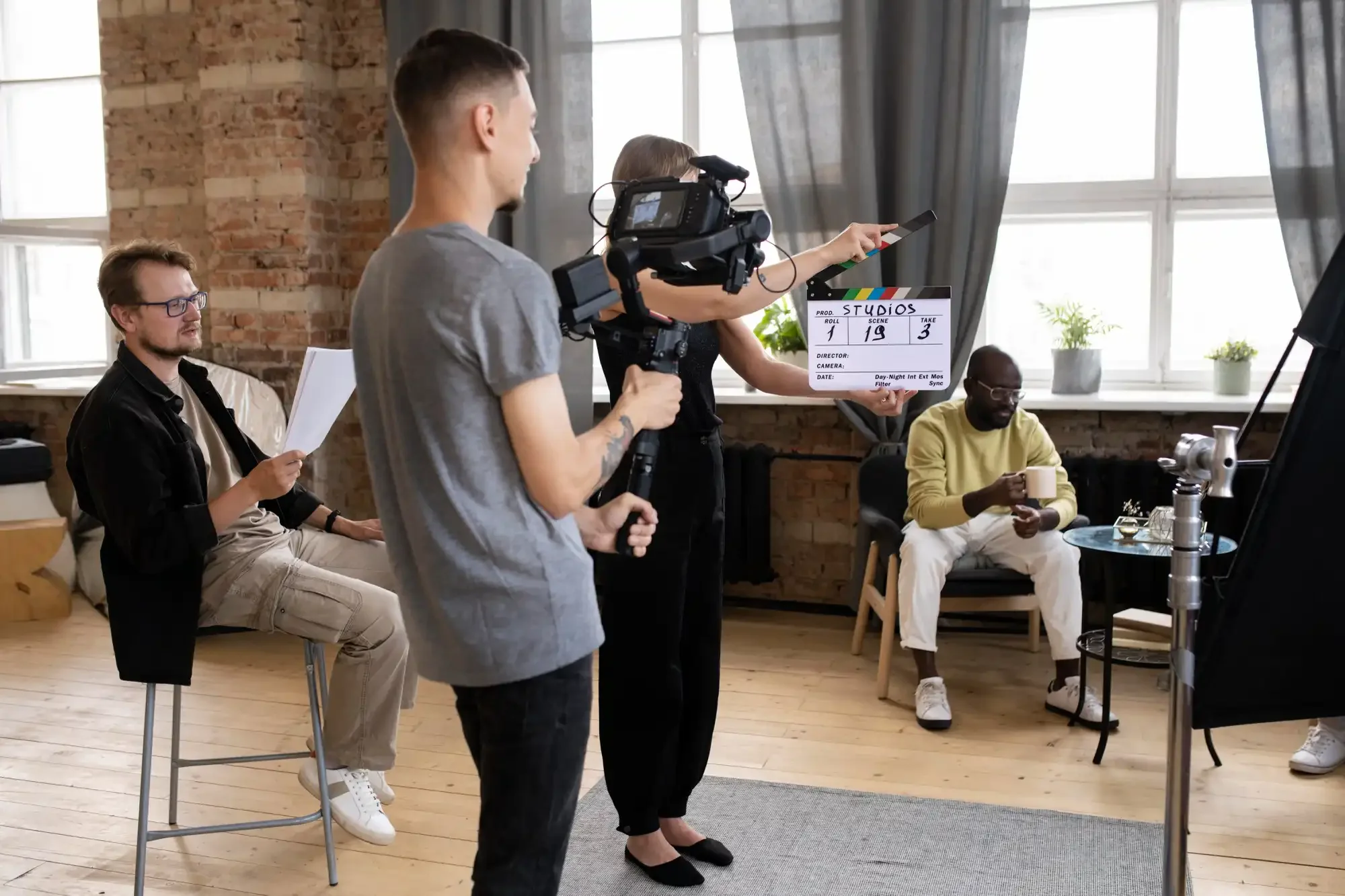
This is the big day—when concepts become reality and cameras start rolling. For many clients, this is the most exciting (and sometimes nerve-wracking) part of the process.
What to Expect When the Crew Arrives
The crew will arrive at the scheduled call time to set up equipment, lighting, and audio. Depending on project complexity, setup can take 30 minutes to several hours. This isn't wasted time—proper setup makes the difference between amateur-looking footage and professional results.
Your production company should have a clear plan for the day. They'll walk you through the schedule, answer any questions, and make sure you're comfortable with the process.
Your Role During Filming
Your involvement during production varies by project type:
If you're on camera: You might feel nervous—that's totally normal. A good production team will help you relax and get comfortable. They'll do multiple takes if needed, and they'll coach you on pacing, body language, and delivery.
If you're not on camera: You'll mainly be available for questions and to approve what's being captured. You might review footage periodically to ensure the team is getting what you envisioned.
At Burt's, we keep you involved enough that you feel confident about what we're capturing, but not so much that you're micromanaging every detail. We've done this hundreds of times—trust the process.
Flexibility and Problem-Solving
Even with meticulous planning, things happen. Maybe the lighting isn't quite right. Maybe an interview subject is running late. Perhaps you realize mid-shoot that you want to capture something additional.
Professional production companies roll with these changes. They adapt, problem-solve, and find creative solutions. This flexibility is part of what you're paying for—not just equipment and technical skills, but experience handling unexpected situations.
Wrapping Up
At the end of the shoot, the production team will pack up equipment and debrief with you. They'll confirm they captured everything needed and discuss next steps for post-production. This is your chance to raise any concerns or request additional shots if something feels missing.
Phase 5: Post-Production
Once filming wraps, the footage heads to post-production—where editors transform raw footage into a polished final product. This phase typically takes longer than production day itself.
The Editing Process
Your editor will review all footage, select the best takes, assemble the video according to the script or shot list, add transitions, graphics, and effects, color correct footage for consistency, mix and master audio, and add music and sound effects.
For short-form video content, the editing approach differs from long-form. Short content needs faster pacing, attention-grabbing openings, and optimizations for mobile viewing. Your production company should understand these platform-specific requirements.
First Draft Review
You'll receive a first draft (sometimes called a rough cut) for review. This is your opportunity to provide feedback on pacing and flow, message clarity, visual elements, music choices, and any sections that need adjustment.
Be specific with your feedback. Instead of "I don't like this part," try "Can we slow down the pacing in this section?" or "The music feels too upbeat for our brand."
Revision Rounds
Most contracts include a specific number of revision rounds (typically 2-3), as recommended by industry standards. The American Society of Media Photographers provides guidelines on standard contract terms for video production projects. Use these strategically:
First revision: Address major issues—structure, messaging, any missing elements.
Second revision: Fine-tune details—timing adjustments, minor copy changes, graphic tweaks.
Final revision: Polish—small adjustments to perfection.
If you need additional revisions beyond what's included, there's usually an additional cost. This is why clear communication during pre-production and the first review are so important.
Approval and Final Delivery
Once you approve the final version, the production company will deliver your video in the agreed-upon formats. This might include a full-resolution master file, web-optimized versions, social media-specific formats like square or vertical, and different lengths such as 60-second, 30-second, or 15-second cuts.
They should also provide guidelines for how to use and share the video effectively.
Phase 6: Distribution and Follow-Up
Creating great video content is only half the battle. The other half is getting it seen by your target audience.
Distribution Strategy
Your production company might help with distribution strategy, depending on your agreement. This could include recommendations for where to post the video, optimal posting times and frequency, caption and hashtag suggestions, and paid promotion strategies.
At Burt's, content strategy and distribution are core services we offer. We don't just create videos and walk away—we help ensure your content actually reaches and resonates with your audience.
Performance Tracking
Good video production companies want to know if their work is driving results. They might check in weeks or months after delivery to ask how the video is performing, whether you're seeing the results you wanted, and what could make the next project even better.
This feedback loop helps both parties improve and builds a stronger working relationship for future projects.
Ongoing Partnership
Many clients start with a single video project and then continue working with the same production company for future needs. This ongoing partnership benefits both sides:
For you: The production company already understands your brand, style, and needs. Projects move faster and require less explanation.
For them: They can plan resources better and often offer improved pricing for repeat clients.
At Burt's, some of our best client relationships have lasted years. We've become extensions of their marketing teams, consistently creating video content that supports their business goals.
Special Considerations for Different Video Types
The general process outlined above applies to most video projects, but specific video types have unique considerations.
Social Media Video Content
Short-form video for platforms like TikTok, Instagram Reels, and YouTube Shorts has a faster production process. There's less planning time since concepts are simpler, faster shooting schedules that are often just hours instead of full days, quicker turnarounds measured in days instead of weeks, and a more iterative approach that involves testing and refining based on performance.
The trade-off is that you're typically producing higher volume at lower individual cost per video.
Podcast Video Production
Video podcast production has its own workflow. This includes episode planning and guest coordination, multi-camera setup for dynamic angles, real-time recording that's less controlled than traditional video, episode-specific editing, and creating social clips from longer episodes.
If you're launching a podcast, your production company should help with the entire ecosystem—studio setup, recording workflows, and repurposing content for social media.
Product and Brand Videos
Product and brand videos often require detailed product photography and videography, specific lighting setups for product shots, multiple angle captures, lifestyle footage showing products in use, and longer post-production for polished results.
These projects typically have longer timelines and higher production values than social content.
Timeline Expectations
How long does the entire process take? It varies significantly by project complexity, but here are general guidelines:
Simple Social Video: 1-2 weeks total. According to Video Marketing Institute research, most professional video projects require 2-4 weeks from concept to delivery.
Kickoff to production: 3-5 days
Production: Half day
Post-production: 5-7 days
Brand Video or Commercial: 4-6 weeks total
Kickoff to production: 2-3 weeks
Production: 1-2 days
Post-production: 2-3 weeks
Large Multi-Video Project: 2-3 months total
Kickoff to production: 3-4 weeks
Production: Multiple days spread over weeks
Post-production: 4-6 weeks
Rush timelines are sometimes possible for an additional fee, but quality work takes time. Don't sacrifice the quality of your video by forcing an unrealistic timeline.
Cost Factors That Impact the Process
Understanding what drives video production costs helps you make informed decisions about your project scope.
Pre-Production Complexity
More complex pre-production (detailed scripts, storyboards, location scouting) adds time and cost. Simple projects with straightforward concepts require less upfront investment.
Production Day Requirements
Factors that increase production costs include longer shoot days, more crew members needed, specialized equipment like drones, gimbals, or special lighting, multiple locations, large cast or many interview subjects, and travel requirements.
Post-Production Intensity
Post-production costs vary based on edit complexity, amount of footage to review, graphics and animation needs, color grading requirements, and sound design and music licensing.
If you're curious about specific pricing, check out our detailed guide on how much video production costs in Raleigh, NC.
Red Flags in the Video Production Process
Not all video production companies follow professional processes. Watch for these warning signs:
Vague Proposals: If the proposal doesn't clearly outline what's included, timeline, and deliverables, push for clarification.
No Contract: Professional companies use contracts that protect both parties. No contract means no protection if something goes wrong. The Freelancers Union emphasizes the importance of written agreements for all creative projects.
Unclear Pricing: "We'll figure it out as we go" is not acceptable. You should know costs upfront.
Poor Communication: If they're hard to reach or slow to respond during the sales process, it won't improve after you sign.
No Portfolio: Legitimate video production companies have portfolios showing their work. If they can't show examples, that's a problem.
Unrealistic Promises: If it sounds too good to be true (incredibly low prices, impossibly fast timelines, guaranteed viral success), it probably is.
Getting the Most Out of the Process
Here's how to maximize your video production experience:
Be Prepared
Have brand assets ready including logos, fonts, and color codes. Know your key messages before the kickoff, review and respond to drafts promptly, and have decision-makers available when needed.
Communicate Clearly
Be specific with feedback, share examples of videos you like and don't like, ask questions when something's unclear, and voice concerns early rather than late.
Trust the Expertise
You hired professionals for a reason. While you should absolutely share your vision and provide feedback, trust their creative and technical expertise. They've done this many times before.
Think Long-Term
Consider how this video fits into your broader content strategy, plan for related videos or follow-up content, and build a relationship with your production company for future projects.
The Burt's Media Approach
At Burt's, our process embodies our four core promises:
Show up on time: We meet deadlines, arrive when scheduled, and deliver when promised.
Do what we say we're going to: No surprises, no scope creep, no hidden fees. We deliver exactly what we agreed to.
Create dang good content: We don't just make videos—we create content that moves the needle for your business.
Don't quit until the job is done right: If something's not working, we fix it. We don't walk away until you're happy with the result.
This approach has served our clients well for years. We've built long-term partnerships with brands across Raleigh, North Carolina, and beyond by consistently delivering great work without the fluff and ego that can plague this industry.
Ready to Start Your Video Project?
Now that you know what to expect when working with a video production company, the process should feel less mysterious. Yes, creating professional video content involves multiple steps and takes time. But with the right partner, it's a smooth, collaborative process that results in content you're proud to share.
At Burt's Media, we handle everything from concept to delivery—and we're here to guide you through every step. Whether you need short-form social content, brand videos, podcast production, or a complete video marketing strategy, we've got you covered.
Want to discuss your next video project? Get in touch and let's talk about what we can create together. No fluff, no pressure—just an honest conversation about your goals and how video can help you reach them.
Frequently Asked Questions
-
Simple social videos typically take 1-2 weeks from kickoff to delivery. More complex brand videos or commercials usually require 4-6 weeks. Large multi-video projects can take 2-3 months. Rush timelines are sometimes available for an additional fee.
-
Have your brand assets ready (logos, fonts, colors), know your key messages and target audience, identify who needs to be on camera, and have examples of videos you like. Your production company will help refine these elements during the kickoff call.
-
Most video production contracts include 2-3 revision rounds. This is typically sufficient if you provide clear feedback and review drafts thoroughly. Additional revisions beyond what's included usually incur additional costs.
-
Ownership terms should be clearly outlined in your contract. Most agreements grant you full rights to use the video for your business purposes. Some might retain certain rights for portfolio use. Always clarify ownership before signing.
-
You'll review drafts and provide feedback during post-production. Most companies don't have clients present during the actual editing process (it's time-intensive and tedious), but you'll see multiple drafts and have input on the final result.
-
Minor changes after final delivery typically incur additional fees since the project is considered complete. Major changes would require starting a new project. This is why thorough review during the revision process is so important.
-
Look for a strong portfolio, client testimonials, clear communication, detailed proposals, and professional contracts. They should be responsive, answer your questions clearly, and have realistic timelines and pricing.
-
Production companies typically have larger teams, more resources, and can handle bigger projects. Freelancers might offer lower rates but have more limited capacity. Neither is inherently better—it depends on your project needs and budget.
